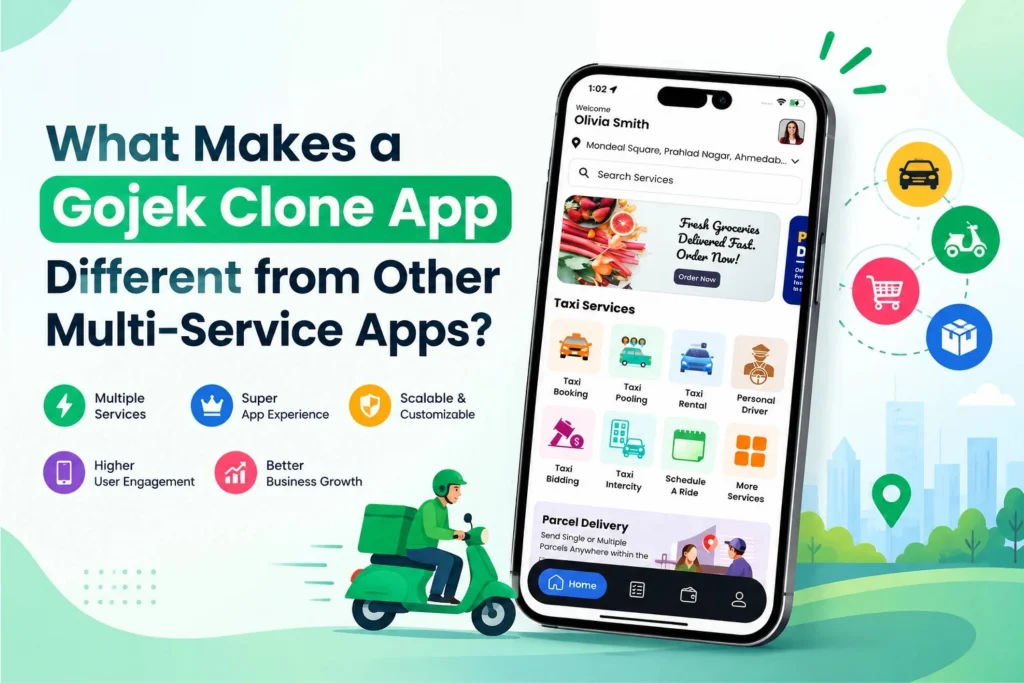
According to several statistics, customers are inclined towards apps that allow them to complete various tasks such as booking rides, ordering food, scheduling deliveries, and accessing local services through one app; hence, the increase in demand for multi-service applications.
But certain multi-service apps are very different in terms of business models. However, a Gojek Clone app is different as it brings together a variety of on-demand services under one single digital ecosystem instead of operating each service independently.
This model also provides an opportunity for entrepreneurs to cater to a variety of requirements of different customers on a single platform. It is important for businesses to understand how Gojek-style solutions are different from other types of multi-service apps to choose the right technology and features.
What Is a Gojek Like App?
The Gojek-like app is a digital platform that operates by merging different on-demand services into one digital hub.
Users are no longer required to download multiple apps to avail different services like food delivery, transportation, courier services, or domestic helpers. One common interface is needed to access all the different services.
In traditional multi-service apps, the services provided are generally limited to one or two categories. But in the case of a Gojek clone model, it can support a wide range of services according to the requirements of the business model and the market.
For example, a single platform could include:
- Taxi and ride-hailing booking
- Food and grocery deliveries
- Parcel and courier delivery
- Cleaning and home repair
- Beauty treatments and personal care services
- Local shopping and other on-demand services
The main advantage is the integration of different service categories within a unique operational framework, while retaining each category to maintain its own workflow.
Gojek Clone vs Other Multi-Service Apps: Key Differences
Despite their similar resemblance, these platforms’ operational approaches and expansion opportunities can greatly differ from one another.
| Comparison Factor | Gojek Style Application | Conventional Multi-Service App |
| Service variety | Can accommodate a number of unrelated service categories | Typically concentrates on a narrower range of services |
| Customer experience | One account and interface for multiple needs | May offer limited cross-category functionality |
| Provider management | Supports different provider types and service workflows | May be designed around a specific provider category |
| Revenue opportunities | Can generate different types of revenue: commission, service charge, subscription | Revenue depends on its chosen service categories |
| Expansion potential | New service categories can be introduced over time | Expansion may involve considerable structural modifications. |
The distinction is based upon the actual architecture of products. Not all Gojek-like solutions are equipped with every service, and sometimes conventional platforms may have similar capabilities as well.
How Multi-Service Architecture Supports Business Growth
In multi-service app development, strategic planning involves much more than just adding the home screen with various buttons offering different services. Rather, it provides one common foundation for maintaining customer accounts, payments, notifications, location tracking, offers, and also administrative controls.
For example, a customer who uses an app for booking a cab service can also opt for ordering groceries without registering a new account.
At the same time, the app enables the business to manage service categories that may run under a common administration system while maintaining different prices for various services and having their own provider requirements and booking procedures.
This structure can support three important business advantages.
- Cross-service engagement: Already active consumers can discover additional services on the same platform, creating more opportunities for repeat transactions.
- Centralized operations: A common dashboard and reporting tools can assist in enhancing the quality and quantity of booked services, payments made, and efficiency of services provided.
- Flexible expansion: Additional services can be introduced based on customers’ demand, what service providers offer, and conditions in the local market.
However, to expand successfully, the need for trustworthy service providers, successful promotion campaigns, and high-quality services is critical. Without technology, it is impossible to facilitate business development.
Gojek Clone App Development: Features That Make a Difference
For a platform to work effectively, it should offer functionalities that support both shared operations and the requirements of certain services. So, the evaluation of a Gojek like app must be based on practical capabilities rather than the number of advertised services.
- Unified customer application
With the help of one consistent interface, customers can register once, manage their profile, browse categories of services, make payments, and look through their order history.
- Dedicated provider applications
Moreover, drivers, courier partners, and service professionals also require specialized tools like booking acceptance, availability management, navigation, earnings, and job status updates.
- Centralized administration
An admin should have the ability to maintain service categories, commissions, providers, promotions, conflict resolution, and performance reports from a single interface.
- Flexible payments and monetization
The availability of a variety of payment options, the option of digital wallets where supported, setting up commissions, and having prices for specific services allow businesses to implement a suitable revenue model.
These capabilities are used to differentiate the genuine integrated platform from a bunch of various applications operating under one brand.
Super App Development and the Ability to Scale
The comprehensive concept of super app development refers to an approach where a digital platform is created for users to get various services from a common entry point. In accordance with that principle, the Gojek-style model combines service discovery, service booking, payments, and communication with customers.
The general difference between a basic multi-service app and an expandable ecosystem appears in how strong the tech behind it is and whether it support expansion of the application. Businesses must check if the current tech allows for additional categories to be configured without needing to rebuild the application.
A scalable architecture should enable increasing bookings as well as different provider processes, service-specific prices, and changing customer needs. This is especially crucial for businesses that plan to grow in the market and expand in different locations or offer their services step by step.
What V3Cube Offers for Businesses Planning a Gojek-Style Platform
For businesses considering the Gojek Clone solution, V3Cube provides a robust platform equipped with ready-to-use and customized application offerings that can help in launching an on-demand business.
In addition, V3Cube can also offer a white-label Gojek Clone that allows businesses to launch a platform to operate under their brand name without building the entire product independently. The Gojek Clone software from V3Cube proves ideal for entrepreneurs looking for the right set of features for customer, service providers, and admin functions.
When assessing On-Demand app development, businesses need to determine whether the selected solution is capable of supporting the required service categories, payment integration, operational workflows, and plans for further development.
Based on the above factors, the business should get a demo of the product and check the features included in the solution as well as its costs in terms of customization, source code and licensing conditions, lead time, and support process. These checks help determine whether the proposed solution offers the right balance of speed, flexibility, and long-term value.
Which Business Model Is the Right Fit?
An ecosystem of the Gojek solution might be suitable for entrepreneurs looking to deliver a variety of services under one brand and to expand new categories over time. More focused applications may work better when a business depends on one service or when specialized working procedures are needed.
When making a choice for a multi-service business application, the criteria should include the target audience, the existing network of providers, the competitive environment of the region, and the number of available resources.
On the same note, an on-demand service application based on a specific category may facilitate a simpler business launch in cases where there is a need to check market demand first before expanding.
Conclusion
A Gojek-style platform is unlike any other conventional multi-service platform because it has the unique ability to integrate diverse services into a single coordinated ecosystem.
Shared user accounts, provider management, central administration, and the possibility of future expansion serve as a basis for a sizable on-demand business.
For a business or entrepreneur, the priority should be to select the correct technology to operate the intended services successfully.
By evaluating V3Cube or any other provider according to clear requirements criteria, documented price, and future business needs, they can define the best way to launch the service.
FAQs
Q1. Is a Gojek-style app different from a regular delivery app?
Yes. A Gojek-style platform is able to integrate numerous unrelated service categories like transport, food delivery, courier service as well as home services.
Q2. Can a Gojek Clone support different service categories?
Yes. Businesses should ensure that every service category possesses an appropriate booking process, service provider protocols, pricing rules, and payment capability prior to launch.
Q3. Is a ready-made solution suitable for startups?
It can be ideal for startups looking for a ready-made foundation instead of developing all functionalities from ground up.
Q4. Can a multi-service app generate revenue from several sources?
Yes. Potential revenue sources are commission from bookings, delivery charges, membership fees, provider plans, and advertising placements.

More Stories
How to Choose the Best SEO Company in USA for Your Business
Uber Clone Web Booking vs Mobile App Booking: Which Is Better?
Improve Digital Marketing with Odoo Dashboard Features and Reports