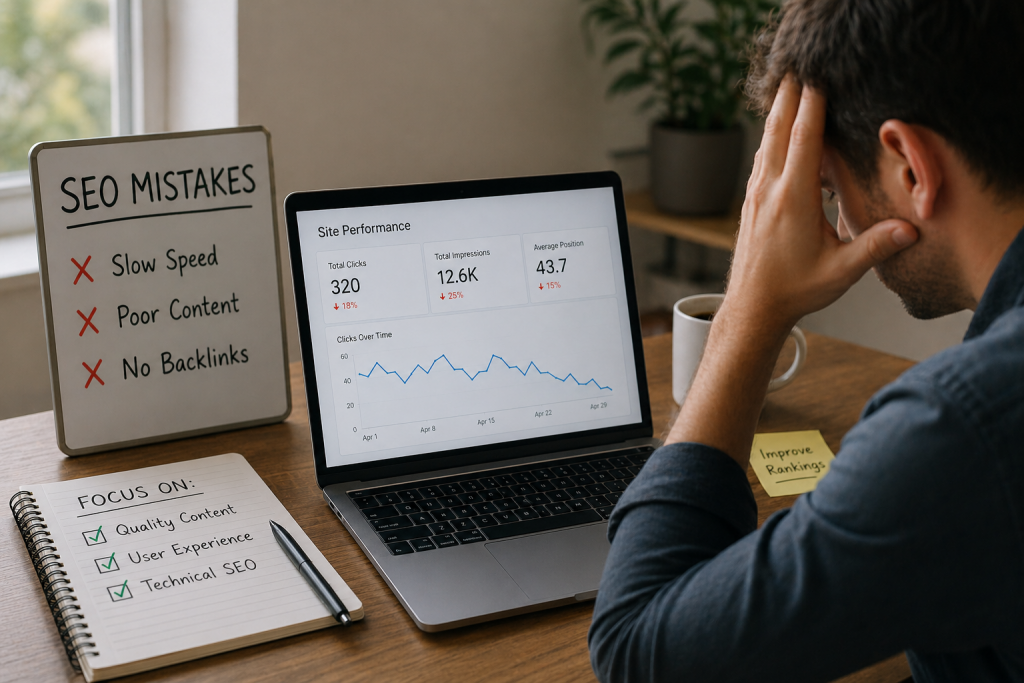
Many businesses put a lot of effort into building a website, but they fail to appear on Google. It becomes perplexing at times. You publish something, update the pages, try this and that, but the traffic does not grow. Meanwhile, competitors appear in search results effortlessly and attract visitors.
The reason is hardly ever a big mistake. It is a collection of small SEO issues that are holding your website back slowly. Even businesses offering quality SEO services disregard these basics. This makes search engines have difficulty understanding the website, which leads to the hiding of website pages.
What Does Website Visibility on Google Mean?
The term “website visibility” refers to how easy it is for people to find a website when conducting a Google search. If Google searchers see several pages from your site on the first page, your visibility is good. If they are far down in the results, most users will not reach the site.
For example, if there is someone searching for a service you provide, and your website is displayed close to the top in their search, you will be much more likely to get such users to click on your page. If there is no visibility of the site, there are chances that users will opt for other alternatives without having the chance to see the business.
Visibility is not one keyword. It is about appearing in search results related to your services and customer needs.
Why Some Websites Stay Invisible on Google
The state of invisibility is maintained on a website that cannot be clearly understood by Google and does not provide its users with any helpful information. Sometimes the problem is technical the speed is low. Other times it is content that is not fit for the search.
Many website owners emphasize only the publishing of contents and neglect the structuring, clarification, as well as performance of the website. All these small issues add up and drastically reduce your chances of ranking.
Now, step by step.
Not Understanding Search Intent
Search intent is the rationale for a query. Simply put, if your content does not match up with what users expect, it will not rank well.
If a user searches for the “best SEO tools,” they expect to see a list or comparison of the best SEO tools. And if your page is dedicated to promoting only one service, it will not deliver the expected result.
To improve this, focus on:
- What the user tries to solve.
- And what kind of content is already ranking.
- How you can provide clearer or better answers.
Finally, with optimized content, there is a natural improvement in rankings.
Using Keywords the Wrong Way
Keywords are important, but they must not look unnatural. This makes the content strenuous to peruse because many websites make certain that a keyword is repeated too many times.
On the other hand, some pages contain a lack of relevant terms, which complicates the recognition of the topic by search engines.
It is better to use related keywords and write naturally. Don’t focus on repeating the same keywords. This helps to rank for more variations of a search.
Poor Page Structure
If your content is not organized, users will run away in no time. It is difficult for users to read long paragraphs without headings.
Another factor that search engines tend to rely on is structure to understand a page. Without doubt, structure is an important element in SEO, and short paragraphs and clear headings increase the readability as well as the SEO
It is important not to lose the reader’s attention by structuring the page properly and guiding the reader step by step.
Slow Website Speed
Speed is a significant factor in user experience and ranking. Rankings and UX significance associated with speed; if your website takes long, visitors will exit without clicking further into your page.
This increases the bounce rate, which in turn affects your ranking on Google. Having a well-developed and good content website will still lose traffic if the website is slow.
Simple measures can rectify this:
- Reduce the size of big images.
- Remove redundant scripts.
- Get a reliable hosting provider.
There are a variety of small things to tweak that could make your website quicker and more user-friendly.
Ignoring Mobile Users
Browsing is mostly done on mobile devices now. Most users now browse on mobile devices, and if your website is not mobile-friendly, you are losing a large part of your audience.
A mobile-optimized site should be easy to read, quick to load, and simple to navigate. If a user finds it difficult to use your site, he/she will exit instantly.
The ranking of websites based also takes into consideration the mobile version, which is why, this factor must not be ignored.
Publishing Weak Content
Content with no value will not rank well. A lot of websites are posting short or common articles that do not answer actual questions.
Search engines prefer content to be focused, clear, and useful. It should help the reader get a new understanding of something or help solve a problem.
Instead of writing more, focus on writing better content. It’s trust that sustains engagement.
Ignoring Internal Linking
Internal links are links within your pages that send a signal to search engine crawlers about the architecture of your website. Without them, you have isolated pages.
An internal linking strategy promotes navigation and SEO.
Simple ways to use internal links are;
- Naturally link to blog posts.
- Link information pages to service pages.
- Use anchor text that is rather obvious to the meaning.
Not Tracking Performance
Many website owners focus on publishing content but do not track how it performs. Without data, it is difficult to know what is working and what needs improvement.
SEO is not a one time affair. It requires continuous monitoring and adjustment; Tools like analytics and search console can present information concerning traffic, keywords, and user behavior.
Performance tracking assists you;
- Pages that bring traffic
- Analyze user behavior
- Develop weakly performing pages
Without this feedback, growth becomes slow and unpredictable.
Overlooking User Experience
SEO is no longer all about search engines. SEO is now about people. If people cannot easily navigate your website, they will leave fast.
Usability refers to a number of things. Layout, clarity of the website, ease of navigation are some examples. Having an organized website that is user-friendly can go a long way.
When your site gets more attention from users, this is reflected to search engines. Thus, the odds are that you rank higher than those with poor usability.
Conclusion
A website is hardly ever unsuccessful due to any large mistake. Rather there are a lot of little things that pile up which cause a website to under-perform. Not recognising search intent, poor content, slow load times, and a lack of organisation all contribute to low visibility.
On the bright side, these kinds of mistakes can always be rectified since they are so easy to amend. Another step that will help you slowly raise your website’s ranking is focusing on meeting the needs of users, providing high-quality content, and organizing your site effectively.
SEO is about consistency, organization, and relevance. When these three things are met, then visibility becomes effortless.




More Stories
How to Choose the Best SEO Company in Singapore for Your Business
How Transparent VAT Pricing Can Improve Shopify Store Conversions
How Health Brands Can Use Visual Search to Reach More Consumers