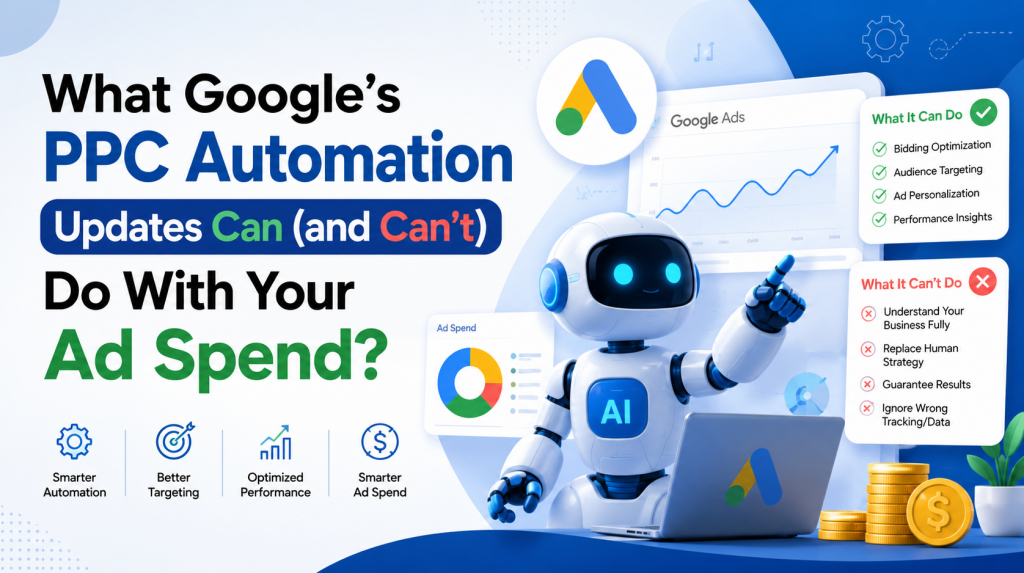
Google recently rewrote its terms to authorize campaign building by default. A major system update is rolling out to clamp down on budget-limited bidding.
With the massive platform push toward a fully hands-off ad ecosystem, it certainly feels like the era of manual tweaking is over. But before you panic, let’s look at the hard facts. The short answer is no, human strategy isn’t dead. However, the line between what the machine controls and what the human protects has been permanently redrawn. So here is exactly what PPC automation can and cannot do with your ad spend right now.
What is PPC Automation and How Does It Handle Your Bidding?
PPC automation refers to using machine learning and artificial intelligence to manage tasks that humans used to do manually. Years ago, a media buyer would spend hours adjusting bids by pennies, building massive keyword lists, and organizing rigid ad groups.
Today, Google’s algorithms analyze millions of real-time signals like a user’s exact location, device, time of day, and immediate search intent. Through automated PPC, the system determines the perfect bid for the right person at the exact moment they search.
Because the machine can process this data instantly, relying on manual bidding is no longer competitive. In fact, fighting against automated PPC campaigns by trying to micro-manage bids manually is a fast track to wasting your budget. The tactical, repetitive grunt work of daily bid adjustments has officially been handed over to the machine.
Why AI PPC Management Still Needs a Human Pilot?
If the machine is so smart, why can’t businesses just hit “start” and walk away? The truth is that AI PPC management is a powerful engine, but it completely lacks a steering wheel.
Algorithms operate on a strict rule: Garbage in, garbage out. An AI doesn’t inherently know the difference between a high-value customer who will buy from you for years, and an accidental clicker or bot. It only optimizes for the specific goals you tell it to track.
If a human strategist doesn’t properly set up advanced tracking, clean up first-party data, and feed the system accurate business insights, the PPC campaign automation will optimize your budget to find worthless, low-quality leads. The machine handles the speed, but the human must handle the direction.
Furthermore, when everyone uses the exact same automated settings, marketing becomes commoditized. If you and your three biggest competitors all rely entirely on basic PPC automation without human intervention, your ads, targeting, and messaging will look identical. The human touch is what provides the competitive edge. Only a human understands true customer psychology, brand positioning, and unique emotional hooks that make a consumer actually want to click.
Bidding in the AI Overview Era: Where Do Your Ads Actually Appear Now?
With the massive rollout of AI Overviews, traditional search pages are turning into dynamic, AI-generated reading summaries. To capitalize on this, Google has deployed AI Max for Search, an advanced optimization layer that moves beyond traditional keywords into a fully “keywordless” ecosystem.
Your ads are no longer strictly confined to the standard text spots on a results page. Through PPC campaign automation powered by these updates, your business assets are dynamically woven into entirely new surfaces. Ads now appear directly inside or underneath conversational AI summaries when the algorithm detects buying intent.
The machine handles the placement, using text customization to instantly rewrite your headlines and descriptions to match the user’s specific conversational prompt. But this is exactly where the strategist becomes irreplaceable. If a human doesn’t provide clear text guidelines, term exclusions, and strict brand guardrails via tools like AI Brief, the generative system might alter your messaging in a way that breaks compliance or dilutes your brand voice. The algorithm determines where the ad goes inside the AI summary, but the strategist dictates the boundaries of what it’s allowed to say.
The Future of Automated PPC Campaigns: What Strategists Must Do Next?
The role of a media buyer has shifted from a data-entry clerk to a high-level business strategist. To thrive in this new landscape, you must adapt your approach to PPC automation from execution to orchestration.
Here is your checklist for surviving and winning in the modern ad approach:
- Guard Your Conversion Data: Ensure your tracking is flawless. The success of your PPC automation depends entirely on the quality of the data signals you feed it.
- Master Creative Strategy: Spend less time on bid tweaks and more time on positioning, copywriting, and visual assets. The algorithm can distribute the ad, but your creative must convert the human.
- Understand Business Realities: Teach the algorithm about your business context like profit margins, supply chain shifts, and customer lifetime value, so it optimizes for actual revenue.
Ultimately, automation isn’t here to take your job; it’s here to free you from spreadsheets so you can focus on real marketing strategy. The floor of average performance has been raised by AI, but human strategy remains the only thing that raises the roof.
How Big Brands Use Enterprise PPC Automation
As businesses grow, the complexity of managing ads across different regions, languages, and thousands of products skyrockets. This is where enterprise PPC automation becomes essential.
Large corporations use enterprise PPC automation to sync their live inventory directly with their ad accounts. For example, if a major retailer runs out of a specific shoe size in their warehouse, the automated system can instantly pause ads for that specific product variation across the globe.
However, even at the highest level of spend, companies do not leave their PPC automation on autopilot. They employ expert strategists to act as “data architects.” These professionals connect the company’s internal CRM (Customer Relationship Management) software directly to the ad platform. This ensures that the PPC automation software is trained on actual closed revenue and profit margins, rather than just superficial clicks.

More Stories
What Makes a Gojek Clone App Different from Other Multi-Service Apps?
How to Choose the Best SEO Company in USA for Your Business
Uber Clone Web Booking vs Mobile App Booking: Which Is Better?