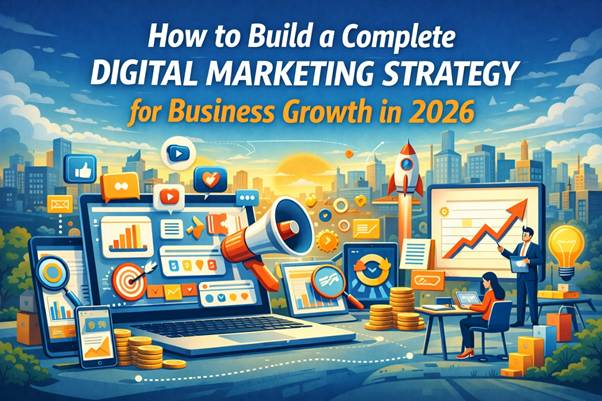
Why Digital Marketing Strategy Matters More Than Ever in 2026
In 2026, having a good digital marketing strategy is of the key pillars ensuring that companies achieve sustainable growth, especially in the face of a highly competitive environment. As people switch to digital communication, the process of reaching them and gaining their trust has undergone fundamental changes. Today’s customer is accustomed to smooth personalized and real-time interactions through several digital platforms. Thus, organizations are forced to focus on the needs of their audience and develop a flexible digital marketing strategy.
On the other hand, in today’s increasing competition businesses have to differentiate themselves by finding something unique and different that would make them stand out. Since companies spend vast amounts of money on search engine optimization and advertising on social media, creative thinking may prove beneficial under these circumstances. However, to achieve success, a company should rely not only on intuition and experience but also on the information provided by analytics tools.
Finally, technological advancements like AI have revolutionized marketing strategies as well, now a company can automate many processes, analyse vast quantities of data quickly, and provide more personalized offers —essential tools for companies operating in competitive markets such as the Sales Performance Management.
Defining Clear Business Goals and Target Audience
To successfully deploy a digital marketing strategy in 2026, the goals that the company wants to achieve and its target audience have to be defined clearly and concisely. Businesses need to use SMART model—setting goals that are specific, measurable, attainable, relevant, and time-bound—to ensure an effective digital marketing process. The goals could be to increase web traffic, improve conversion rates, and boost customer retention among others, and the goals have to be quantifiable.
It is also important for businesses to identify their ideal customer – what they need, and what challenges they face. Businesses need to develop these personas as they help shape marketing campaigns. Moreover, it will also useful for companies to segment their target audiences according to factors such as demographics, buying behaviour, and preferences.
Finally, the marketing goals have to align with the business’ goals. This ensures that there is synergy in operations, which in turn helps the business become efficient, productive, and even profitable.
Leveraging Data, AI, and Automation for Smarter Marketing
For a successful digital marketing plan, one will have to leverage data, AI, and automation. For instance, it is vital for organizations to use analytical instruments to observe customers actions, analyse the performance of various campaigns, and receive information about users online activity. Thus, marketers would be able to make rational decisions and fine-tune their strategies to achieve better results.
Furthermore, the integration of AI is also an important element that increases the success rate of different marketing efforts. Using artificial intelligence, organizations can predict customer’s needs, suggesting related goods or services, and personalizing content delivery to ensure high customer satisfaction levels.
At last, automation is another powerful tool to boost marketing activities. The use of automation technologies helps organizations to automate the process of running various email campaigns, follow up clients, and maintain communication with them. Therefore, marketers will save plenty of time and energy since they will be able to concentrate on making new decisions.
Creating a Strong Omnichannel Presence
Creating a strong omnichannel presence have a comprehensive effect on clients irrespective of when and where they are, giving them a continuous experience. Businesses should use various channels such as SEO, social media marketing, email marketing, and pay-per-click marketing. Each channel will perform its role some will generate traffic, whereas others will help build the relationship.
Consistency is the key aspect here, especially when it comes to the way businesses interact with customers. No matter whether users come to the company’s website or watch ads on social media, their experience will be consistent as far as the messages go.
Moreover, companies need to pay attention to the user experience that they provide to the audience and make sure that no matter what device their visitors use, they have access to fast and comfortable interaction. Lastly, integration of online and offline platforms can help build a more efficient customer journey for the clients of the company.
Content, SEO, and Personalization as Growth Drivers
The combination of content creation, search engine optimization (SEO), and personalization can be very effective when it comes to growing your business through marketing initiatives. The first step in such an approach is to create quality content that solves problems and provides insights to the readership.
In addition to creating content, it is crucial to optimize it for the purpose of increasing its visibility online. It involves using appropriate keywords, backlinks, as well as implementing a set of technical aspects that will improve content ranking and performance on the internet.
Apart from that, businesses can consider applying a personalization strategy to increase the effectiveness of the messages sent to clients. Email campaigns, recommendation systems, or other types of personalized content can help make customers feel appreciated and heard.
Finally, it is important to pay much attention to the modern types of content. For example, short videos and quizzes can be more engaging compared to static images and texts.
Conclusion
To conclude, the development of a proper digital marketing strategy is crucial for a company’s prosperity in the year 2026. Amidst the competition and new customers’ demands, it is vital to take a data-driven and customer-oriented approach. Goal-setting, audience analysis, and using technologies such as AI, automation, and analytics will allow firms to make more informed decisions and save time and resources. It is also important is to create an omnichannel presence and to focus on producing good content that is relevant and customized to your customers.


More Stories
What Makes a Gojek Clone App Different from Other Multi-Service Apps?
How to Choose the Best SEO Company in USA for Your Business
Uber Clone Web Booking vs Mobile App Booking: Which Is Better?