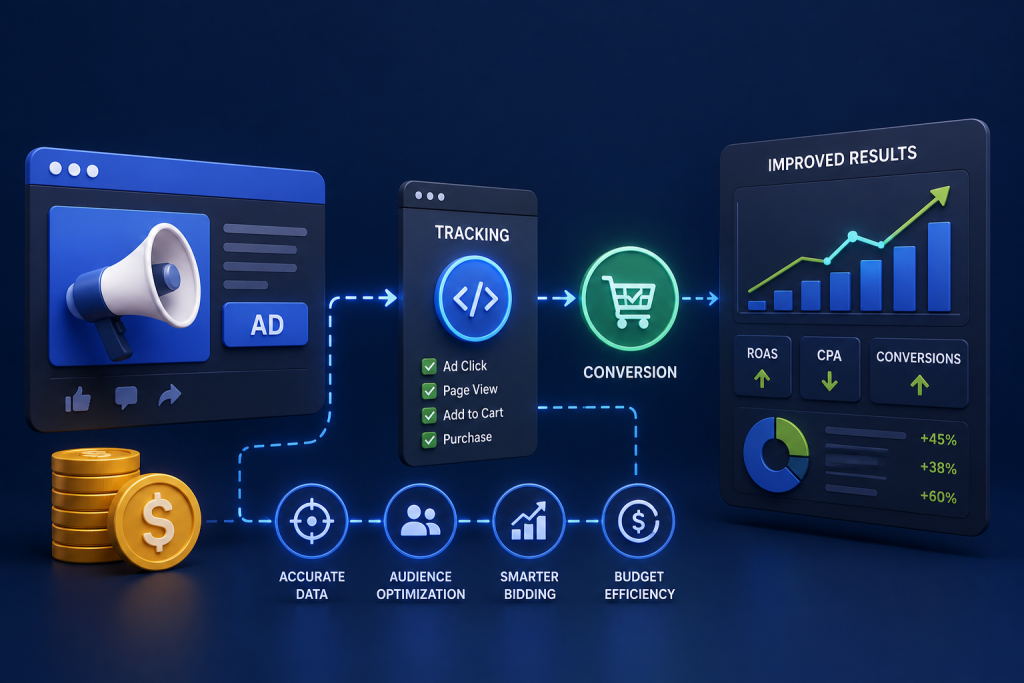
In the current competitive digital market, companies are spending a lot of money in paid advertisements in a bid to get customers, create leads and revenue. Such services as Google Ads, Facebook Ads, Instagram Ads, and LinkedIn Ads offer great opportunities to engage the targeted audiences. But when advertisements are run without measuring outcomes then it may result in loss of funds and opportunities. The book How Conversion Tracking Improves paid advertising Results assists businesses in utilizing the conversion tracking to optimize their returns on investment and decision-making on marketing with data.
Regardless of whether a company is collaborating with a marketing agency or a web application development company in Saudi Arabia, monitoring customer activity following an ad- click makes up valuable information regarding the performance of a campaign. Conversion tracking assists companies to determine what advertisements, keywords, and audience segments are actually producing real results. By having the right data, marketers will be able to optimize campaigns, target better, and enhance the effectiveness of the advertising efforts.
What Is Conversion Tracking?
Conversion tracking involves tracking certain activities that users perform after being exposed to an advertisement. These are conversions which are worthwhile business objectives like:
- Online purchases
- Contact form submissions
- Newsletter sign-ups
- Phone calls
- App downloads
- Appointment bookings
The gathering of this information will enable businesses to know what marketing initiatives will directly help them achieve their goals.
Why Conversion Tracking Is Important
Clicks, impressions, and traffic of the site are some of the measurements that many advertisers concentrate on. Although such numbers are helpful, they do not necessarily mean success. A campaign can yield a lot of clicks yet minimal sales.
In this point, How Conversion Tracking Improves advertising performance is made very apparent. Conversion tracking is used to understand which campaigns have meaningful business outcomes in lieu of the measurement of activity.
Better Performance Measurement
Proper performance measurement is one of the greatest benefits of conversion tracking. Businesses are able to identify the ads, campaigns and audience groups which yield the most conversions.
Key metrics include:
- Conversion rate
- Cost per conversion
- Return on ad spend (ROAS)
- Customer acquisition cost
These lessons can guide marketers towards strategies that are able to produce quantifiable outcomes.
Improved Budget Allocation
The budgets on advertising should be utilized in areas where they generate the greatest value. Conversion tracking can assist the business in creating more successful campaigns and removable unneeded expenditure.
Benefits include:
- Cutting on spend on ad wastage.
- Putting more investment in the winning campaigns.
- Improving campaign profitability
- Increasing the efficiency of marketing in general.
This is an indication of How Conversion Tracking enhances financial decision-making in paid advertising campaign.
Enhanced Audience Targeting
Advertising messages do not have a similar impact on all audiences. Conversion tracking offers a good insight into the users who are most likely to act.
Marketers can analyze:
- Age groups
- Locations
- Interests
- Devices
- Customer behaviors
Such insights enable businesses to design an extremely focused campaign that can reach potential customers in a more efficient way.
Better Ad Optimization
Effective advertisement requires the communication of the appropriate message to the appropriate audience. Conversion tracking enables marketers to experiment with various ad variations and find out which ad variations result in the most conversions.
Businesses can optimize:
- Headlines
- Images
- Videos
- Ad copy
- Calls-to-action
Enhancing these aspects will make a campaign more effective and promote more successful marketing results.
Supports Data-Driven Decisions
The contemporary marketing is based on the precise information as opposed to presumptions. Conversion tracking is a good way of knowing what works and what does not work.
Businesses can also analyze actual conversion data, instead of making assumptions about the success of a campaign. This data-driven method eliminates risk and enhances the overall campaign performance.
Improved Keyword Performance
In the case of search advertising campaigns, keywords have an important role in enticing potential customers. Certain keywords can be traffic but not yield conversions.
Conversion tracking aids business in determining:
- High-performing keywords
- Low-converting search terms
- New keyword opportunities
- Negative keywords
Optimization of key word tactics can help the advertisers to get better output of their campaigns by making them efficient.
Strengthening Remarketing Efforts
A lot of users come to a site without a purchase or enquiry made. Remarketing enables companies to be able to reach out to these prospective consumers via specific adverts.
Conversion tracking aids in tracking the visitors who:
- Viewed products
- Abandoned shopping carts
- Visited key pages
- Submitted forms
Remarketing campaigns using this information may have better conversion rates since the users are already known with the brand.
Improved Automated Bidding
Machine learning and automation are becoming more popular in advertising platforms as a performance-optimizing factor. Conversion tracking serves as the basis of automated bidding strategies to work efficiently.
Some popular bidding strategies are:
- Maximize Conversions
- Target CPA
- Target ROAS
- Enhanced CPC
Proper conversion data will allow advertising platforms to smarterly make bids and optimize campaign results.
Understanding the Customer Journey
Before converting, customers tend to touch on a number of touchpoints. Conversion tracking assists companies in knowing the flow of users in the purchasing process.
Insights include:
- First interactions
- Repeat visits
- Assisted conversions
- Multi-channel engagement
Knowing the customer behavior enables the business to design better marketing tactics and enhance the user experiences.
Increasing Return on Investment
Any advertising campaign should result in a good ROI. Conversion tracking assists the businesses to determine the marketing activities that yield the highest returns.
Advantages include:
- Higher conversion rates
- Better lead quality
- Increased revenue
- Improved campaign efficiency
- Stronger marketing performance
These advantages are a clear demonstration of how Conversion Tracking Enhances the overall success of advertising.
Common Conversion Tracking Mistakes
In order to get precise results, a business must not commit the following problems:
- Tracking Irrelevant Actions: You should concentrate on real business objectives and not on vanity measures.
- Incorrect Tracking Setup: Misuse of implementation may result in wrong reporting.
- Ignoring Mobile Users: The percentage of mobile traffic can be a large portion of conversions.
- Failing to Test Tracking Systems: Frequent testing will make sure that tracking tools are working properly.
- Not Reviewing Data Regularly: Constant observation can be used to detect areas of improvement.
Best Practices for Effective Conversion Tracking
The following best practices can help businesses to maximize success:
- Define specific conversion objectives.
- Use effective tracking systems.
- Monitor performance consistently
- Conduct A/B testing
- Optimize campaigns regularly
- Analyze customer behavior
- Review attribution models
- Integrate analytics platforms
These plans assist advertisers to have a better understanding and enhance performance of the campaigns in the long run.
Conclusion
Paid advertising is most effective when businesses understand exactly how their campaigns contribute to revenue and growth. This is the reason why How Conversion Tracking Improves paid advertising Results has become an essential factor to consider by contemporary marketers. Following valuable customer activities, businesses can have a clear vision of campaign performance, audience behavior, and ROI. These insights can be used to make smarter decisions and more effective advertising strategies.
Companies that adopt conversion tracking are able to keep on refining the campaigns, become more effective in targeting, and maximize marketing budgets. With or without the involvement of a web application development firm in Saudi Arabia, the businesses which utilize conversion tracking are more suited to enjoy sustainable growth and the success of long-term advertising. Conversion tracking is one of the most effective tools in enhancing paid advertising in a highly digital environment that is increasingly data-driven.



More Stories
The Growing Importance of Backend Optimization in Websites
Mobile Apps Become a Growing Part of Modern Digital Marketing Strategies
How to Choose the Best SEO Company in Singapore for Your Business