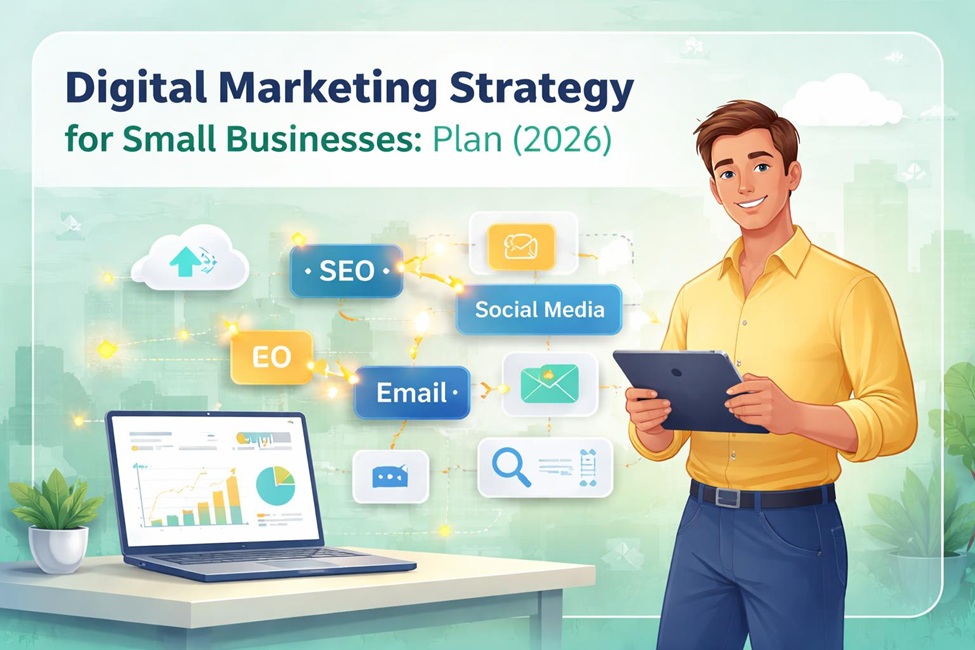
Let’s get real. Digital marketing strategy is not some mystical voodoo. The nature of the game has changed rules since everyone was busy arguing about AI on Twitter, but developing a digital marketing strategy for small businesses in 2026 is quite different from what it used to be two years back.
Presently, 58% of small businesses reach their customers through digital marketing. That is not impressive. That is baseline survival. What separates the thriving from the struggling is not just being online but being smart about it.
You can no longer just throw money at Facebook ads and pray for something to stick because algorithms have changed, your customers have changed, and if you haven’t changed your strategy, you are already behind.
Why Your Old Digital Marketing Playbook Is Gathering Dust
Remember when ranking on Google was the holy grail? When email blasts actually worked? When you could post anything on Instagram and get engagement?
Yeah, those days are done.
Chris Essey, a Fortune 100 marketer, nails it: “Visibility no longer depends on shouting louder or posting more often. It depends on being understandable, credible, and useful across the places where decisions actually form.”
Read that again. Understandable. Credible. Useful.
Not louder. Not more frequent. Not flashier.
Your customers are drowning in content. They scroll past hundreds of posts daily. They ignore promotional emails. They’ve developed an immunity to traditional marketing tactics that would make a virologist jealous.
So what works? Let’s break it down properly.
The Foundation: Know Your Bloody Audience
This isn’t revolutionary. But here’s what’s wild—most small businesses still skip this step, even though every single person in marketing harps on about it constantly.
They make content for everyone. They target “people interested in our product.” They guess what their customers want.
That’s like throwing darts blindfolded and hoping you hit the bullseye.
Seth Godin put it bluntly: “Don’t find customers for your product; find products for your customers.”
Flip your entire approach. Start with the people you serve, not the thing you’re selling.
Here’s how:
- Actually talk to your customers (shocking, right?)
- See what questions they ask on social media
- Look at your competitor’s reviews—what complaints keep recurring?
- Use tools like Google Analytics to see what content they engage with most
- Create customer personas that are not just demographic data but actual humans with real problems
When you know their pain points, this is the language they speak, this is how they behave in search—that’s when a digital marketing strategy for small businesses actually starts working.
Multi-Channel Strategy: Stop Putting All Your Eggs in One Basket
Here’s a stat that will make you sit up and pay attention. Combining SEO with social media advertising delivers three times more leads than either channel alone.
Three times. Not even ten percent more—THREE BLOODY TIMES!
Yet most small businesses appear hell-bent on mastering just one platform. Going all-in on Instagram, or piling everything into Google Ads, building an email list then promptly ignoring it.
It’s a bad call.
Your customers hop channels. They watch a quick video on TikTok, check out some details through a Google search result, land on your Facebook page to read reviews and finally notice your promo email sitting pretty in their inboxes. Speaking of which, mobile app development florida firms build solutions that function across every touchpoint because they get the integrated approach.
This is how real life plays out down here at ground level.
2026 Multi-Channel Approach:
- SEO for when they’re actively searching
- Social media for discovery and community
- Email for nurturing and retention
- Paid ads for strategic acceleration
- Video content for engagement
Each channel talks to the other. Miss one, and you’ve got gaps in your funnel.
Content That Actually Matters (Not Just Content That Exists)
Let me tell you something that’ll save you thousands. More content doesn’t equal better results.
I have seen a small business set up three blog posts per week that go unread by anyone. Instagram stories that disappear into the void. Videos gathering dust.
Long live the king: quality with purposeful quantity.
Let Us Be Realistic Here: This Is What Your Content Needs to Do
Solve one specific problem for a specific person. That’s it. That’s the big secret formula everyone overcomplicates.
Not “5 Ways to Improve Your Business.” That’s generic trash.
How Texas BBQ Joints Cut Food Costs 30% Without Changing Suppliers. Specific. Useful. For someone.
💡 Marketer Milk Blog insight: “Your competitive advantage as a marketer is in your taste. It’s in how you think about the design of things, whether it’s a logo, a content strategy, or a customer journey.”
Taste matters. Design matters. But not the way you think.
It’s not about pretty. It’s about effective for your users.
Video Marketing: The Format You Can’t Ignore Anymore
Over 53% of small businesses are investing more in video marketing in 2026. If you’re not one of them, you’re voluntarily sitting out the most engaging content format.
Video isn’t optional anymore. It’s table stakes.
But here’s where most businesses mess up—they think video means expensive production, professional equipment, and Hollywood-level editing.
Wrong.
Your phone is fine. Natural lighting works. Authenticity beats polish every single time.
What actually converts:
- Behind-the-scenes content showing your process
- Quick tips that solve real problems
- Customer testimonials (the raw, unscripted kind)
- Product demonstrations that aren’t sales pitches
- Educational content that establishes expertise
Put them on YouTube. Slice for Reels. Share to TikTok. Add clips in emails.
One video post can drive the whole content strategy for a week.
Social Media Is Now a Search Engine (Wrap Your Head Around That)
This one’s massive and most people are sleeping on it.
💡 Neil Patel (@neilpatel): “In 2026, platforms like TikTok, YouTube, and Instagram will function more like search engines than feeds. And that means everything about how you plan, create, and measure content is about to shift.”
Most underestimate the fact or do not even realize this at all. Social media is becoming the new search engine. Envisage the amount of traffic entering your pages through social accounts if they were perfectly optimized for discoverability.
Content needs future-proofing because soon social will swap from feed-based to search-based.
People have stopped Googling “best coffee shop Sydney.” They are searching on Instagram. They ask TikTok. They scroll YouTube.
Your social content needs SEO now. Keywords in captions. Hashtags that match search intent. Alt text. Video descriptions.
It changes everything about how you make content. It’s not just posting pretty pictures. It is being findable when someone searches for what you offer.
Email Marketing: The Channel Everyone Declared Dead (That’s Very Much Alive)
Email marketing generates $36-$42 ROI for every $1 spent.
Read that number again. Thirty-six to forty-two dollars return on every dollar spent.
That’s better than almost any marketing channel. Better than most paid ads. Better than most social media campaigns.
But here’s the twist. The emails that work in 2026 aren’t the ones you think.
Polished newsletters with graphics and branded templates? They’re landing in the promotions tab where they die quietly.
Here’s the thing about plain text emails. They get delivered into primary inboxes two or three times more often than big designed promo messages—and open rates follow deliveries upward.
Write your email strategy like this:
- Write your email like a normal person, because you are one
- Choose the right segment of people to send it to—offers blasted out look exactly like spam
- Give some actual value in your message before asking for anything at all
- Set up automation so that it works smart, not hard
- Keep testing because last month’s winner could be this month’s loser
Most small businesses totally over-complicate email. Do not annoy your list by sending crap. That is 80% of the game.
AI: Your Assistant, Not Your Replacement
Let’s clear something up. One-third of small business owners are already using AI and another 27% plan to adopt it in 2026.
But here’s what they’re not doing—they’re not letting AI run everything.
Chris Essey hit the nail on the head: “For small businesses, success comes from clarity rather than automation. AI tools work best when the business defines its services, audience and expertise with precision.”
AI is not magic. It is a tool. A very good tool, but still just a tool.
Here are some smart ways to use AI in 2026:
- Content brainstorming and first drafts (then edit heavily)
- Social media scheduling and optimization
- Email personalization at scale
- Data analysis and pattern recognition
- Customer service chatbots (for basic questions)
And here are the dumb ways people will use it:
- Publishing AI-generated content without editing
- Letting it make strategic decisions
- Using it to replace human connection
- Relying on it to understand your brand voice
- Thinking it knows your clients better than you do
The companies making the most out of artificial intelligence are using it to perform redundant activities and thus free up time for strategy, creativity, or developing relationships.
Reality Check on Budgets: What Should You Really Be Spending?
Most small businesses dedicate between five and ten percent of their revenues toward digital marketing. But that number is meaningless without context.
At five percent, a $500K business has $25,000 yearly for marketing. That’s just over $2,000 per month.
What can you do with $2,000?
- Run Google Ads campaigns
- Post on social media
- Build and nurture an email list
- Create consistent content
- Maybe a little part-time help or key tools
What can’t you do? You can’t be everywhere. You can’t dominate every platform. You can’t compete with businesses spending ten times more.
Here’s what actually matters. ROI matters. Results matter. Revenue matters.
If you are spending $2,000 per month and making over $6,000 in revenue that can be directly linked or attributed to your marketing efforts, keep going. If you’re spending $2,000 and getting squat back in return—something’s broken.
Here’s a budget allocation breakdown that works:
- 30-40% on paid advertising (Google, social)
- 20-30% on content creation (writing, video)
- 15-25% on tools/software
- 15-25% testing/experimenting new things
- 10-20% when needed for professional help
None of these are rules. They’re starting points. Adjust based on what works for your business.
The Trust Factor: Why Nobody Cares About Your Features
Seth Godin’s philosophy many have come to trust: “Marketing is not a battle, and it’s not a war, or even a contest. Marketing is the generous act of helping someone solve a problem. Their problem.”
Stop selling features.
Nobody cares that your app has 47 integrations or that your service uses “cutting-edge technology.”
They care about their problems. Their frustrations. Their goals.
Your digital marketing strategy for small business should focus on trust. Trust, by the real problems you solve.
Trust-building tactics:
- Share customer success stories (real ones)
- Be transparent about pricing and processes
- Admit when something isn’t right for someone
- Provide free value before asking for anything
- Respond to negative feedback publicly and honestly
People buy from businesses they trust. Not with the best-looking website or most followers.
Measuring What Matters (Not Vanity Metrics)
Likes don’t pay the bills. Followers don’t keep the lights on. Views don’t cover payroll.
Yet I see small businesses celebrating these numbers while ignoring the metrics that actually matter.
Things they completely ignore while obsessing over their next big viral moment:
- Customer acquisition cost (CAC)
- Customer lifetime value (CLV)
- Conversion rates at each funnel stage
- Return on ad spend (ROAS)
- Email engagement rates
- Revenue attributed to marketing efforts
And here are a few that don’t:
- Total follower count (unless converting)
- Post impressions (without engagement)
- Website traffic (without conversions)
- Email list size (without opens/clicks)
- Vanity awards and recognition
Track what drives revenue. Everything else is noise.
The Economic Reality of 2026
Let’s get to it. Sixty-six percent of SMBs say economic uncertainty will be somewhat or very challenging in 2026.
Translation: budgets are tight. Competition is fierce. Every dollar counts.
That does not mean you cut marketing; that means you get smarter about it.
How to Market During Uncertainty
Retain rather than acquire. It’s less expensive to keep a customer than get a new one. Drive your email list aggressively—owned channels for the win when all budgets collapse in paid media.
Do more of what works. Stop doing what does not work. Test smaller. Move faster.
Above all, articulate the value very clearly. When cash is strapped, people need to know exactly why they should choose you.
Looking Forward: What’s Coming in the Next 12-18 Months
The change isn’t slowing down. The change is speeding up.
💡 David Visser (CEO of Zyber and Unlocked): “AI will become every marketer’s copilot, rapidly building flows, testing variations, and personalizing messages at scale.”
By late 2026 and into 2027, expect:
- AI-powered personalization becoming standard (not cutting-edge)
- Social search completely replacing traditional search for many queries
- Video-first content strategies becoming mandatory
- First-party data mattering more as privacy regulations tighten
- Automation handling more tactical work while humans focus on strategy
💡 Blake Imperl (SVP Marketing at Digioh): “As CACs continue to rise and cookies disappear, the smartest brands in 2026 will focus on activating data across the funnel—turning quiz and preference data into personalized journeys that convert.”
Those who adjust first win big. Those who do not will be working overtime in 2027 to compensate for lost time.
Most Common Mistakes Made by Small Businesses (And How Not to Make Them)
Having watched hundreds of small businesses attempt to execute digital marketing, the same obvious mistakes appear over and over again.
Mistake 1: Trying to be everywhere
You cannot possibly master seven different platforms with a team of two people. Select two or three channels and become very strong on them.
Mistake 2: Inconsistency
Most people blast every day for two weeks and then disappear for a month. That kills all momentum. Consistency is far more important than intensity.
Mistake 3: Ignoring data
Your analytics tell you what’s working and what isn’t. To not use them is to drive blindfolded.
Mistake 4: Copying competitors
Their audience is different. Your audience is different. Their positioning was different, your positioning is different—so are the results.
Mistake 5: You Think Results Will Be Instant
Digital marketing results grow with time and effort put into it. Suppose results in the third month are double that of the first month; in the sixth month, they could be double that of the third month. Give it time.
Action Steps: What to Do Tomorrow Morning
You’ve read this far—great. Now actually do something with it.
Your 90-day digital marketing strategy for small businesses:
- Week 1-2: Audit your current presence. What’s working? Where is the waste? Get brutal, cut it.
- Week 3-4: Define your audience. Build customer personas. Detail them. Research their real behavior.
- Week 5-8: Select your core channels (no more than three). Set up tracking. Content calendar.
- Week 9-12: Execute. Consistency. Valuable content. Authentic engagement. Different approaches. Test.
- Ongoing: Measure weekly, adjust monthly, review quarterly, stay flexible.
Stop over-complicating things. Done is better than perfect. Consistent action eventually always outweighs spurts of genius.
The Bottom Line
In 2026, the digital marketing strategy for small businesses does not involve having the largest budget. It’s not about being present on every platform. It’s not about chasing every trend.
It’s clarity. Consistency. Value.
Know your audience well and serve them genuinely, show up consistently, measure what matters and optimize based on data—that’s it! That’s the whole game!
They’re not doing anything revolutionary. They’re just nailing the basics. Trust over vanity metrics. Deliver value before asking for a sale. Treat the marketing as a generous act of solving problems, not a battle to be won.
Will things change in 2026? Of course they will. AI will evolve. The platforms will shift and algorithms will update but at the very core—serve your audience, build trust, provide value—never changes.
Stop reading about strategy—go build yours now.


More Stories
How Compliance and Digital Marketing Work Together in Fintech Growth
How Strategic SEO Helps Businesses Grow in the UAE
How Website Translation Helps with Local SEO?