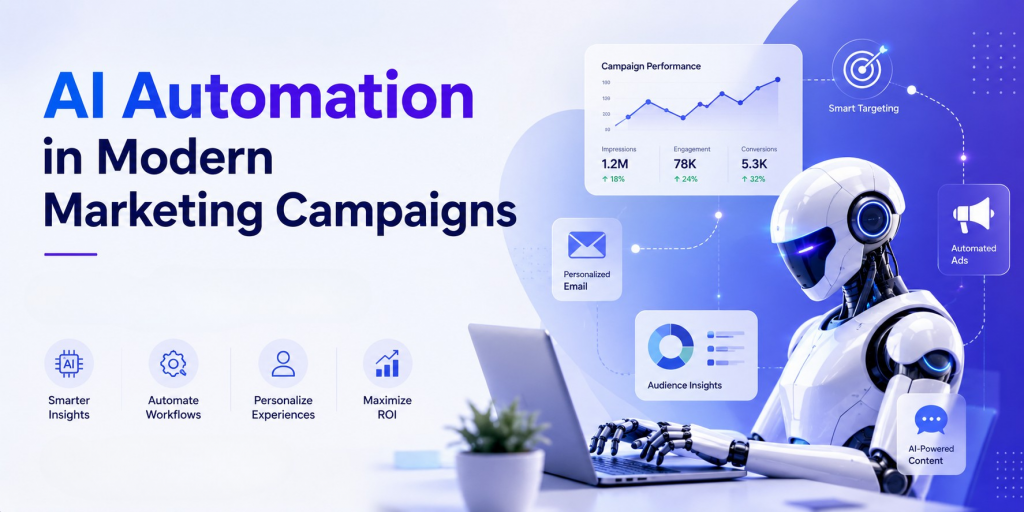
Today, the marketing ecology is going through a seismic shift. Enterprises struggle to handle huge volumes of data across disconnected digital touchpoints and this results in inefficient manual orchestration. Enterprise marketing teams are leveraging machine learning, natural language processing, and algorithmic approaches to deliver at scale.
According to a global survey undertaken by IT research firms, the market value of artificial intelligence in marketing has surpassed $62 billion. 56 percent of marketers are directly employing business AI solutions in production environments.
The use of AI marketing automation is no more a tactical experiment, but a core architecture to handle real-time consumer engagement, and to stay in a strong position in the digital-first economy.
Core Pillars of AI Marketing Automation
Transitioning from legacy, rules-based triggers to autonomous workflows requires structural changes. Traditional automation is based on rigid “if this, then that” routes. While newer automated systems use AI marketing automation to dynamically evaluate client behavior and alter messages without any human interaction.
- Dynamic Omnichannel Orchestration: Algorithms rapidly analyze customer interactions across search, social media, and email channels. When a prospect watches a given product video, the automation engine updates the user profile, and tailors future touchpoints with the user across other networks, based on that specific intent.
- Algorithmic Content Optimization: Machine learning algorithms look into the past engagement insights and develop the best email subject lines, push alerts, and copy variants. More than half of corporate marketing teams (51%) employ automated tools to identify text trends and customize messages for certain target segments.
- Hyper-Personalization Frameworks: Solutions that use real-time first-party data to drive individualized experiences rather than demographic groups. That’s why CPGs are increasingly developing personalized product suggestions, specific pricing regulations, and unique information streams at the moment of digital contact.
Shifting Focus from Reactive to Proactive with Predictive Data
One of the greatest difficulties for marketing teams is relying entirely on historical performance data. The history of prior campaigns does not predict what will happen in the future. This is where the strong mathematical models used in organisations’ AI marketing automation software come in handy.
Predictive analytics services may help firms make better forecasts for consumer behavior with a higher level of certainty. The worldwide predictive analytics market is growing rapidly and is expected to reach $27.5 billion. That’s a fast speed, and it’s because data is becoming intelligence that’s forward-looking and has value for business organisations.
Enterprise marketing setups utilize predictive systems across several critical use cases:
- Lead Scoring & Conversions: Machine learning algorithms look at historical purchase funnels and incoming behavior data. This enables dynamic sales teams to target active prospects that are more likely to convert.
- Churn Prevention Models: Algorithms analyze user behavior to identify signs of reduced account activity or changes in interactions that suggest churning. Then the automation engine may trigger custom retention campaigns before the user fully disengages.
- Demand and Trend Forecasting: Predictive models use inside sales speed and external economic data to predict demand. The alignment helps ensure the right budget is allocated to the right products at the right time, when they’re in demand, and helps avoid wasting ad budget on low-inventory SKUs.
Ensuring Campaign Precision via Rigorous Software Validation
With the volume of client messages being sent through AI marketing automation processes, a single processing error or tracking failure can mean many thousands of dollars in lost revenue and reputational damage in one day. A bad validation link, inaccurate demographic requirements, or incorrect customization tokens can quickly displease users and lead to data being attributed to the wrong user.
To overcome these operational weaknesses, engineering teams have the need for specialized AI testing solutions. Today’s AI marketing automation engines generate too many assets and variants for traditional QA approaches to handle. Automated validation systems monitor active infrastructure in real time, ensuring 100% data integrity and system stability.
Implementing AI-Powered Marketing Solutions
The corporate environment demands a disciplined strategy for the use of AI-driven marketing solutions, linked to defined business objectives and data accessibility. At no point should organizations pile on the heavy technology without first looking at the infrastructure.
1. Centralize the Data Foundation
The quality of the data that heads into algorithmic engines is the sole determining factor of their effectiveness. Limited system intelligence because data is siloed in the various databases of sales, customer service, and product. Any marketing team will need to compile first-party data into a single platform in order to create a source of truth for downstream automation.
2. Establish Algorithmic Governance
In order to give the communications channels for customers to an autonomous system, the functioning conditions must be defined precisely. Teams need to define stringent rule limits around budget levels, brand-safety criteria, and algorithmic limitations, so that automated judgments are in accordance with business compliance regulations.
3. Deploy Continuous Performance Auditing
To prevent data from drifting, the predictive models’ forecast accuracy should be periodically tested. Otherwise, the accuracy of the models will be diminished as the customers’ behaviour changes over time. Marketing analysts and data engineers need to check performance indicators monthly to ensure that the algorithms are correctly configured.
Overcoming Key Implementation Challenges
Implementing complex automation frameworks can bring in structural challenges. One of the major challenges is the shortage of competencies within the organization. Studies have shown that there is a large disconnect between the skills of traditional marketing staff and the requirements of advanced data analysis for businesses.
This can be accomplished with personalized professional training and interdepartmental collaboration between marketing managers and data science. Other key issues are data privacy compliance. As worldwide rules tighten up the control over what consumers collect, automation systems need to prioritize that consumer privacy.
Modern platforms address this through first-party data strategies and anonymisation methods that ensure advertisements are 100% compliant with local laws and regulations, and provide hyper-personalised user journeys.
Future Trajectory of Intelligent Automation
As machine learning architectures improve, the marketing industry is transitioning from simple task management to autonomous agentic workflows driven by powerful AI marketing automation. Industry estimates suggest that many corporate business applications will have task-specific AI agents that can autonomously carry out multi-step operational cycles.
In the future, systems built on end-to-end AI marketing automation will automatically conduct thorough competitor evaluations, will rebalance budget allocations among live ad channels in real-time based on ROI, and will optimize lead nurturing flows without user configuration. These cognitive platforms allow companies to expand their digital operations successfully in a complicated environment, while minimizing administrative expense and operational friction.




More Stories
How to Choose the Best SEO Company in Singapore for Your Business
How Transparent VAT Pricing Can Improve Shopify Store Conversions
How Health Brands Can Use Visual Search to Reach More Consumers