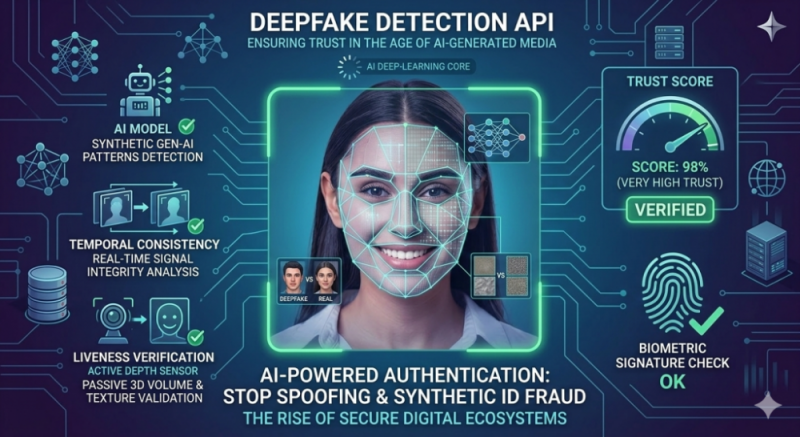
The digital marketing world is changing at a pace never realized before and this is driven by innovations in artificial intelligence, machine learning and computer vision. The emergence of synthetic media, especially deepfakes, is one of the major innovations of the last few years. These AI creations in the form of videos, pictures, and audio files can sound and look real like a person with shattering authenticity. Although the technology has a valid use in entertainment, film and creative industries, there are also opportunities of misinformation, digital fraud, and identity manipulation.
With the development of deepfakes, it is essential to identify the manipulated content. Deepfake detection APIs have become one of the essential methods of recognizing, examining, and verifying digital marketing media in order to retain authenticity. With the implementation of deepfake detection software in online applications, a developer and organization can safeguard their users, uphold confidence, and avert the usage of AIs in ways that are not intended.
Understanding Deepfakes
Deepfakes are artificial media produced with the help of AI algorithms, in particular, with the help of deep learning algorithms and networks like generative adversarial networks (GANs). Patterns in facial movements, voice modulation, and speech are learned in these systems to generate realistic imitations. The most worrying aspect of deepfakes is that they can be convincingly used to look like the authentic representatives of a person, and in many cases, it is almost impossible to notice that the manipulation took place without training in this regard.
Deepfake technology has numerous uses. In entertainment, actors have the ability to be digitally de-aged, recreated, or inserted in scenes that they did not shoot. Brands in marketing have the ability to test AI-created campaigns with public figures. Nonetheless, it is the abuse of this technology that has led to the development of deepfakes detector tools in an urgent manner. Fraudulent videos may affect the opinion of the population, spread disinformation, or ruin reputations.
The Rationale behind the Deepfake Detection
The implications of the proliferation of the manipulated media are far-reaching. False information can influence political campaigns, social media, news media, and even personal relationships. A deepfake can depict the words of a public figure, which he has not said, or people in a fabricated situation. The results may be a damaged reputation, financial fraud, and the possibility of detecting a genuine person may be more important than ever.
Deepfake Detection refers to the operation of detecting a modified or artificially created digital marketing file. Old methods of verification, like human observation, cannot serve the purpose anymore since AI media can be detected by humans. Here is where the deepfake detection technology comes in. These systems examine minute anomalies in pictures, sound, and video in order to raise suspicious crimes.
The mechanism of Deepfake Detection APIs
Deepfake detection API enables developers and organizations to locate detection features in applications, websites, or platforms. The APIs are developed based on the complex machine learning models that have been trained to detect red flags of manipulation.
Detecting processes normally occurs by investigating several attributes of media content. In the case of video, the API can analyze the facial movements, the blinking, the accuracy of the lip-synch, and the head positions. In the case of images, it examines pixel discrepancies, lighting discrepancies, and facial features. In sound, even minor speech deviations, changes of tone, and rhythm can mark out artificial production.
When the analysis is done, the API gives an answer based on the confidence score, or probability, of whether that media is original or altered. This information can then be used by developers to issue alerts, block it out, or even mark it as something that should be reviewed.
The benefits of Deepfake Detection Software
There are several advantages of deploying deepfake detection software. To begin with, it improves confidence and safety in online platforms. Users are able to be sure of the authenticity of the content they see, and the likelihood of being deceived is low. Secondly, it provides organizations with mechanisms to monitor media integrity, enabling prompt detection of malicious or deceptive information.
The other major strength is scalability. Manual detection proves too costly in terms of time and is also subject to error, particularly considering the amount of media uploaded to the internet on a daily basis. Deepfake detectors can be used to scale, perform real-time analysis, and analyze, which results in the ability to track millions of files in an efficient manner.
Additionally, the technology of detecting deepfakes promotes regulatory and ethical obligations. With the introduction of policies surrounding AI-generated content by governments and organizations, a strong detection system is useful, which can help platforms show responsibility and remain ethical.
Industrial Uses
Deepfake detectors will be applicable in a variety of industries. Media and journalism use these tools to verify the authenticity of videos before publishing them, thereby preventing misinformation. Social media websites have detection APIs that block manipulated content and help users to avoid possible scams or harassment.
Deepfake can be used to stop fraud in the financial sector by making sure that the identity verification process performed on video is not circumvented through synthetic media. It is also helpful to government and law enforcement agencies, as the technology can be used to confirm digital marketing evidence or address misinformation campaigns.
The entertainment industry, which is one of the main consumers of the deepfake technology, also uses detection programs to keep the content authentic and to avoid any illegal use of the likenesses of the actors
Difficulties in Deepfake Detection
Although technological improvement has been made, there are still difficulties in detecting deepfakes. Along with the development of the detection models, the deepfakes generation techniques also change. More advanced manipulations which are more difficult to detect are constantly created by AI algorithms. This gives rise to an arms race between the producers of synthetic media and the creators of the detection equipment.
The other threat is the variety of media forms. Video codecs, compression rates and environments used during recording can influence the accuracy in detection. The deepfake detection software should be resistant to these differences and not produce false positives or falses.
There is also user privacy. Detective APIs usually involve processing sensitive media data, and an organization should make sure that information managed is in accordance with privacy laws and ethical principles.
Deepfake Detection Technology Future
Continuous adaptation and integration of the deepfake detection technology is the way to its future. The models of AI will evolve to be more sophisticated and detect the finest manipulations. Real-time detection will be a normal standard in which platforms will analyze a running stream, video call, and uploaded content in real-time.
Detection will also be reliably increased by integrating it with other verification systems, like biometric authentication or metadata analysis. Through the use of a series of checks, platforms have the ability to develop more effective deterrents against AI-based deception.
It will also be important that the technology providers, the researchers and the regulators work together. Knowledge sharing, datasets, and best practices can enhance the creation of efficient deepfake detection tools and create standards in the industry regarding the responsible and ethical use of AI.
Ethical and Social Concerns
Although deepfake detection APIs are used to keep people safe and preserve the trust, an ethical concern should be addressed. The process of setting up flagging/blocking of content needs to be balanced between security and expression. The detection systems must offer transparency of the way the content is rated and the level of confidence of the analysis.
Moreover, companies have to inform users regarding the shortcomings of detection technology. Any system will not be flawless and awareness campaigns can make people analyze the contents of the media more critically as opposed to just using automated tools.
Conclusion
Deepfakes are an effective and revolutionary technology, and the possibilities of their misuse demonstrate why it is vital to be verified. Deepfake detectors and APIs are important in preserving authenticity, securing the user, and ensuring the sanctity of digital marketing media.
Deepfake task forces are able to detect tampered material with greater accuracy by analyzing minor indicators in images, video, and audio. The technology is versatile and essential as it can be applied in media, social platforms, finance, government, and entertainment.
With the development of AI-generated media, the technology of deepfake detection should also improve. The trusted deployment in the age of synthetic media will be based on real-time analysis, integration with other verification systems, and ethical deployment. Through technological innovations, awareness, and responsibility, deepfake detection APIs will provide a way to achieve a safer, more trustworthy online environment.




More Stories
How to Choose the Best SEO Company in Singapore for Your Business
How Transparent VAT Pricing Can Improve Shopify Store Conversions
How Health Brands Can Use Visual Search to Reach More Consumers