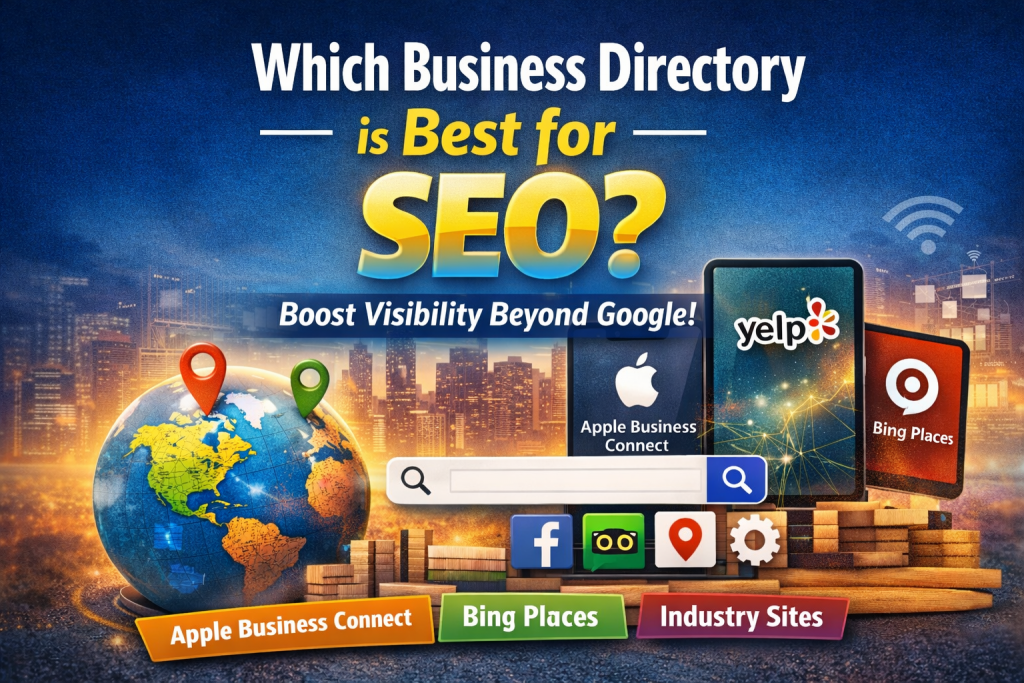
Meta description: Let’s be honest, you’re losing out on a ton of options if your internet presence is solely dependent on Google My Business. Follow the article to know about the best business directories that are best for SEO.
Despite Google’s dominance in search, astute companies understand that diversifying their directory listings is similar to having several lines of business. I mean, you wouldn’t put all your eggs in one basket.
You will learn how to maximise your visibility on important platforms, learn how to use Apple Business Connect, work with Bing Places efficiently, find the best industry-specific directories for your niche, optimise your social media business profiles, integrate review platforms with ease, create strong local citations, monitor the performance of your directories, and future-proof your entire listing strategy.
In actuality, your prospective clients aren’t merely using Google to find you. They are using social media to find businesses asking Siri for recommendations, searching Bing at work (yes, really!), and looking for experts in sector directories. If these touchpoints are overlooked, money will be lost.
Take a moment to consider your own actions. How recently have you used Apple Maps? or requested a recommendation from Alexa? These platforms gather information from various sources, and your rivals will get those clients if you are not present.
Overview of Important Directory Platforms
Okay, let’s break through the cacophony. You don’t have to be everywhere; you just need to be in the correct places. Not all directories are made equal. A significant change has occurred in the directory sector with certain platforms emerging as dominant forces and others fading into oblivion.
The platforms in your core directory stack should genuinely increase traffic and conversions. Instead of vanity listings that appear excellent on paper but yield no results. We’re talking about directories where actual people browse for actual businesses.
Being where your clients are is more important than trying to be everywhere. Yelp and local service directories are more important to a plumber than a LinkedIn company page. A B2B software company on the other hand might invest substantially in LinkedIn and industry-specific platforms but completely avoid Yelp.
What’s intriguing, do you know? Businesses that use numerous directory channels see compound benefits, according to research on marketing channel optimisation. This is because each platform supports the others, generating a network effect that increases overall visibility.
“Many growing businesses are also leveraging independent online business directories to strengthen their citation profile and build diversified traffic sources. Platforms like TekMagListing, for example, allow companies to submit their business listing online and improve local visibility beyond major search engines.”
Optimization for Bing Places
Think about this before you scoff at Bing: Millions of office PCs use Bing as their default search engine, and it fuels 36% of desktop searches in the US. Additionally, several car navigation systems, Alexa and Cortana all display Bing results. You are ignoring a third of desktop search traffic if you ignore Bing.
Unlike Google, Bing Places for Business has special benefits. First off there are less rivals on Bing, so your listing is more likely to stick out. Additionally, the platform has strong integrations with Microsoft’s Edge browser, Teams and Outlook.
The setup procedure is similar to Google’s, although there are some significant variations. Bing makes it simpler to manage several locations by enabling bulk uploads using spreadsheets. In terms of business categories, they provide greater freedom.
Directory Requirements by Industry
The generic directories are only the first step. Industry-specific directories frequently produce higher-quality leads since users are actively looking for businesses just like yours. Compared to a restaurant buried in a broad directory, one featured on OpenTable receives more relevant traffic.
I’ll divide this down by sector. Vitals, Zocdoc, and Healthgrades profiles are necessary for healthcare providers. Attorneys should concentrate on Justia, FindLaw and Avvo. Angie’s List, HomeAdvisor and Thumbtack are too important for home service companies to overlook. Every industry has influential people.
Platforms have quite different requirements. Verification of a medical license and information about malpractice insurance are required by Healthgrades. Avvo requires case history and information about bar admissions. HomeAdvisor needs confirmation of liability insurance and runs background checks. There is no one-size-fits-all solution.
Business Profiles on Social Media
Social media profiles are useful business directories in and of themselves; they are not only for sharing information. Every day, Facebook alone handles two billion queries, and many people only find businesses on social media. Just as much thought should go into your social media profiles as into your traditional directory entries.
These days, Facebook Business Pages serve as little websites. You can highlight every aspect of your company without users ever leaving Facebook with options like Services, Shop, Events and Jobs. Particularly for mobile users the platform’s local search capabilities compete with those of traditional directories.
Instagram business profiles are now more than just photo-sharing accounts. Instagram turns into a comprehensive business platform with connectors for meal ordering, appointment scheduling, and shopping tags. The analytics offered by the “View Professional Dashboard” option are comparable to those of premium products.
Examine the Integrations of the Platforms
Modern enterprises are made or broken by their reviews. However, most people are unaware that review platforms also function as directories. In addition to gathering reviews, Yelp, TripAdvisor and Trustpilot are venues for company discovery where millions of people look for companies every day.
The elephant in the room is still Yelp. Whether you like it or not, Yelp generates a lot of traffic. 92% of customers make purchases after visiting Yelp and the platform receives 178 million unique visits each month. Just as much care should be taken with your Yelp profile as with your website.
The game of integration has evolved. Reviews can be shown on your website, in emails, and in marketing materials thanks to the APIs and widgets provided by contemporary review sites. The value of each favourable review you get is increased by this social proof.
Conclusion:
Begin by going over the fundamentals but don’t stop there. As new platforms appear, test them. Keep an eye on where your clients spend their internet time. Make adjustments to your approach based on outcomes rather than conjecture. Businesses that embrace change while being consistent will be the ones who succeed in 2026 and beyond.
Keep in mind that a potential customer’s initial image of your company is frequently shaped by your directory presence. Make it matter not just on Google but on all platforms. Make sure your potential clients find you because they are looking everywhere.



More Stories
Improve Digital Marketing with Odoo Dashboard Features and Reports
SEO Wilmington: A Practical Guide for Local Business Owners
The Growing Importance of Backend Optimization in Websites