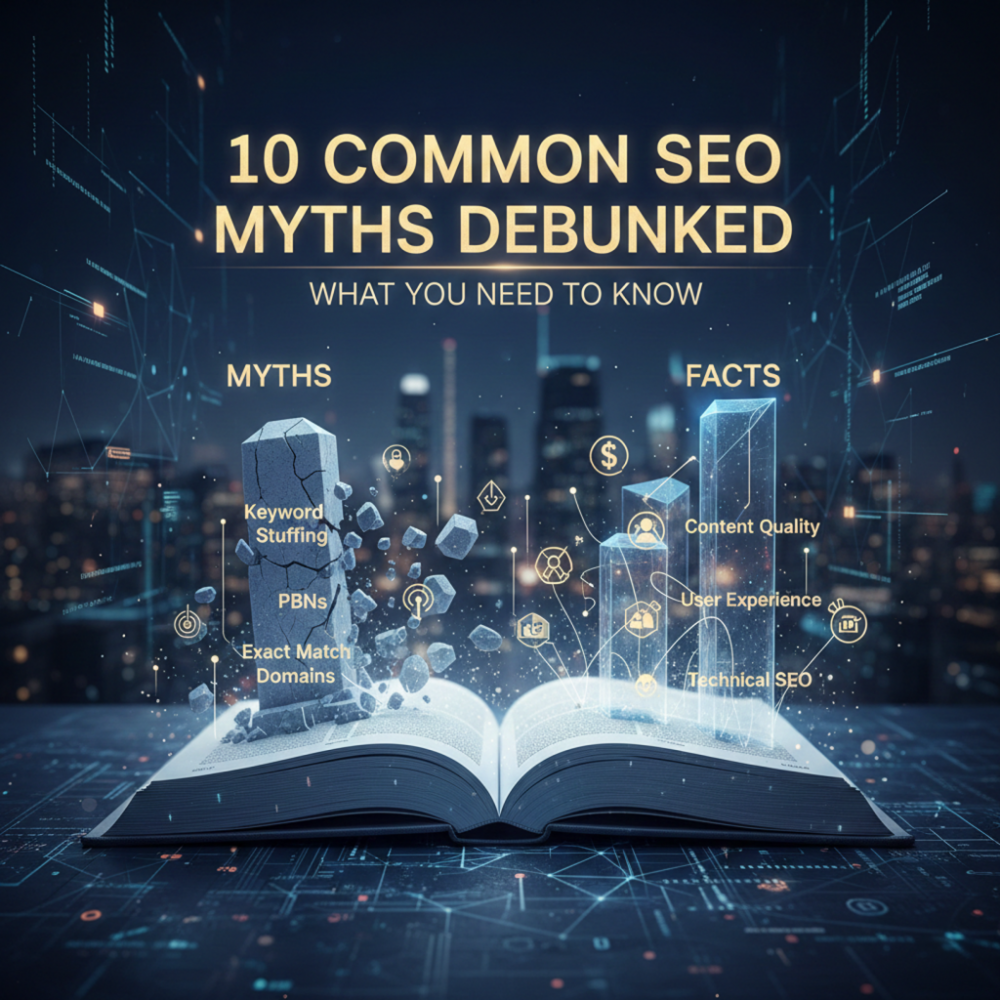
SEO or Search engine optimization is the practice that many businesses opt for who want to increase or show online presence. It aims to increase the quality and quantity of visitors. Because it makes content understandable for the search engines and helpful for users.
However, an outdated SEO strategy can lead to ineffective practices. These include keyword stuffing or buying low-quality backlinks. If you adopt a black hat SEO strategy, then Google will penalize you, and you will also lose visibility.
In this comprehensive guide, we will debunk the most common SEO myths and provide factual information.
Myth 1: SEO Is A One-Time Effort
Many businesses believe that once they implement SEO and that’s enough. But this is a misconception. Because SEO is never a one-time task. Instead, it demands ongoing efforts.
Because of the following things, you need to keep updated.
- Google frequently updates its algorithm. It means that strategies that worked previously are no longer in use.
- Also, competitors are optimizing their websites, and you are not. So they will outpace you and replace your ranking as well.
- Lastly, changing user behavior can also result in different search intent. For instance, now users are choosing more convenient options such as voice search.
Truth:
So the truth is, SEO is a continuous investment. So regularly audit your websites, update old content, and optimize for new keywords. Lastly, track analytics against these parameters.
Actionable tip:
Schedule quarterly SEO audits to identify any broken links on your website. Furthermore, identify the content gaps and replace outdated information.
Myth 2: Keyword Stuffing Improves Ranking
- Initially, it is said that a successful SEO strategy lies in excessive keyword integration, like if the brand is about CV of UAE, then stuffing keywords like Professional Video Resume services UAE without any context or any other relevant information. However, Google now penalizes it. Google highly discourages keyword stuffing.
But why was it a failure? Let discuss
- Because too many keywords make the content unpleasant for readers
- So, unreadable content affects the reader’s experience, which results in less user engagement
- Overall, it affects the algorithms, which ultimately result in penalties from Google
Truth:
So here is the truth. Don’t go for keyword stuffing. Instead, focus on user intent and use as simple language as possible. Because it will make your content easy to understand. Also, place keywords strategically in the meta Title, description, body, or headings.
For instance, if your main keyword is “top digital marketing strategies,” then try to integrate naturally first. Moreover, you can also add relevant synonyms to that keyword. Like SEO tactics.
Actionable tip:
Use tools like Surfer SEO or Yoast SEO for keyword optimization. In this way, you can also avoid overstuffing of keywords.
In the words of Neil Patel:
“Keyword stuffing is a fast track to losing rankings. Google rewards content that’s helpful and natural.”
Myth 3: Meta Tags Are No Longer Relevant
Meta tags include meta title and meta descriptions. However, the term meta keywords is obsolete by most search engines. Because of the negative keyword stuffing.
Truth
In fact, Meta tags are a great way to attract users. Because a high CTR also signals to GOOGLE relevance. So in this way, it impacts SEO. Meta Tags can be divided into two components. One is
Meta Title tells the user what the page is all about. But make sure that your page content is relevant to the title or the other way around.
And the other is
Meta description influences ranking because search engines use them as snippets.
Let’s take an example.
If two blogs are on the same topic, then the chances of getting a click are higher for the blog that has a compelling meta description.
Actionable Tip:
So write the meta description in a way that
- It includes keywords naturally, and adding a primary keyword is a must
- Highlight clearly the benefits of the post and the burning question of the user problem
- And lastly, add a Call to action in it
Google can also rewrite the meta description, but a good meta description improves the chances of favorable display.
Brian Dean of Backlinko says:
“Well-crafted meta tags can dramatically improve CTR, which indirectly signals quality to search engines.”
Myth 4: More Backlinks Means A Higher Ranking
Backlinks are still a crucial factor in determining ranking. But quality matters more than quantity. So you cannot acquire backlinks from any source without considering its quality.
Truth:
A single backlink from a high authority site can be more valuable than dozens of low-quality links. So don’t collect links from less credible or spammy websites. Instead of boosting credibility and authority, they damage your SEO efforts. That’s why Google prioritizes quality over quantity.
Ahrefs reported that pages with high-quality backlinks rank higher, even when competing pages have more content.
Actionable Tip
So, build backlinks in the following way.s
- Guest posting on authoritative websites. This will help you to earn a high-quality website while also reaching a broader audience.
- Creating shareable and high-quality content. Add infographics or images that make it worth sharing. Because high-quality informative content naturally acquires backlinks.
- Networking with the industry influencers. Because building relationships can lead to natural backlink opportunities.
- Lastly, use tools like Google Console or Ahrefs to check the quality of your backlinks.
Matt Cutts, a former Google engineer, states that:
“Backlinks are one of the top ways Google evaluates the importance of a page.”
Myth 5: Social Media Directly Impacts SEO
It is a common misconception that social media can directly influence SEO. So understanding the actual relationship between social media and SEo is therefore crucial to understand.
Truth
Social media does not influence SEO efforts. Social media reactions like likes, comments, and shares do not guarantee ranking. However, social media supports SEO efforts.
Ways social media supports SEO
Increase brand visibility by utilizing social media to attract significant traffic to your website. As people share your content so it reaches a wider audience.
Content distribution: as you share content through social media. This will help to reach a wider audience, and people will share your content, and thus you will also succeed in getting quality backlinks.
Brand awareness: a well-recognized brand is more likely to attract more searches, which indirectly complements SEO.
Engagement metrics: while not directly but high engagement can indicate quality. And quality content is more likely to earn quality backlinks.
Actionable Tip:
So, social media can help improve your ranking. If you use social media in the following ways
- Use social media to promote content.
- Keep the audience engaged with the relevant content
- So ultimately it helps to attract the backlinks
Ann Smarty is a SEO consultant who states:
“Social media amplifies content reach, which indirectly affects SEO through link-building opportunities.”
Myth 6: Mobile Optimization Is Optional
Mobile-first indexing makes mobile optimization crucial. Because a poor mobile ranking can reduce ranking and ultimately the conversions. But still, many businesses believe a website on a desktop is enough. However, as every other person nowadays uses a mobile phone. So a mobile optimization is not optional; it’s a necessity.
Truth
In fact, Google’s shift to mobile-first indexing means that now your mobile responsiveness is the primary factor of indexing and ranking.
Mobile responsiveness benefits in the following ways
- Mobile-friendly sites will load faster
- So it reduces the bounce rates
- Which ultimately improves the engagement as well
On the other hand, a poor mobile responsiveness will negatively impact your SEO Performance. So a mobile-friendly website is crucial for both user experience and ranking.
Actionable tip
Test your website against the Google mobile-friendly test. Then optimize for speed and user experience.
John Mueller, who is a Google Webmaster Trends Analyst, states:
“Mobile optimization is essential. Sites not optimized for mobile may struggle to rank.”
Myth 7: Longer Content Improves Ranking
Google generally does not use word count as a direct ranking factor. However, it is commonly said that the longer content generally addresses the user’s query in detail. So it improves the ranking as well.
For instance
You shared a detailed post based on the user intent. So
- It can improve user engagement
- And a quality user experience also reduces the bounce rate
- Which can overall improve the authority of your website
Truth
Focus on the well-researched content that must address the user intent. Use multimedia, shorter paragraphs, and bullets. So longer content can be easy to scan. Moreover, the most important thing is that it should demonstrate EEAT.
HubSpot found that posts over 2,000 words with in-depth research received 77% more backlinks than shorter posts
Actionable tip
Conduct keyword research to identify the gaps. Then, using these keywords, make listicles or guide-type long content. Because they are generally preferred by the audience. Make sure that it provides value to your users irrespective of the length; quality matters.
Myth 8: Paid Ads Improve SEO Rankings
Paid advertising improves ranking is the common myth. Just because you spend money with Google, Google will also reward you in turn. This is completely false. This is not going to happen.
Truth
Google is not a pay-to-play system. And it never does a favor of ranking. Because the Google algorithm is separated from that. The data used for advertising has no direct impact on the organic ranking.
Actionable Tip
However, you can use data from the ad campaigns to support your SEO campaign
- Firstly, you can understand the audience demographic from the ad campaigns.
- Secondly, you will find the important keywords from the Google Ad Planner. Which you can use in catering to relevant content. This will also help to meet the search intent of the target audience.
The bottom line is you cannot buy organic results. But paid advertising can indirectly benefit SEO.
Myth 9: SEO is All About Ranking On 1
Many people believe that ranking on the first page of the SERP alone is equal to successful SEO. It is undoubtedly of great importance to achieve 1st position. But believing that creates unnecessary stress and unrealistic expectations.
Truth
While being on top can significantly help. But this is not the only way to drive traffic to your website. In fact, the pages that rank 3 or 5 also receive substantial traffic.
Actionable tip
So don’t rely solely on the first page ranking. Instead focuses on user engagement, satisfaction, and conversion. These metrics help to improve a holistic SEO strategy. This will contribute to the overall success of your website, regardless of whether you hold the top position or not.
Myth 10: Content Is King, And Nothing Else Matters
Content is the king is the most famous quote. However, it is not true. Because content is one piece of the puzzle, and you need to look at the whole picture.
Truth
Your great content can not stand alone. If all other factors are not with it. To rule, your content needs to be:
- Craved by your chosen audience.
- In-depth and actionable.
- Authority-level and trustworthy.
Actionable tip
Firstly, earn quality backlinks.
Then keep your content up to date
Lastly, let Google index your content
Conclusion
SEO is nonetheless complex, but understanding the truth behind the myth can save your time, resources, and effort.
By debunking these myths, you can focus on strategies that truly matter
- Quality content creation
- User-focused design and performance
- Building authoritative backlinks
- Patience and consistent effort
Remember, successful SEO is a marathon, not a sprint. So avoid shortcuts and myths. By focusing on sustainable strategies, you will see long-term growth in your search ranking.
Frequently Asked Questions (FAQs)
- Does content length impact SEO ranking?
- Content length is not a direct ranking factor. However, more depth and length in content address the user’s intent clearly. So when users stay for a long time on your website. So it can affect ranking. But user satisfaction is more important than short or long content.
- Is mobile optimization optional for SEO?
- No mobile optimization is not optimal. Because Google shifted to mobile-first indexing thus it is a crucial aspect in SEO ranking.
- Can social media directly impact SEO?
- No social media can directly influence seo. But it has indirect effects such as increasing brand visibility, driving traffic, and earning backlinks.
- Is SEO really a one-time task?
- Absolutely not. SEO is an ongoing process. Because user behavior and Google algorithm keep changing thus it is important to change the O strategy according to it.
More Stories
AI Writing Tools vs Human Content: What Performs Better in 2026
Building Topical Authority Blogs After Google’s Latest Core Updates
Zero-Click Searches: New Content Optimization Tactics for Bloggers