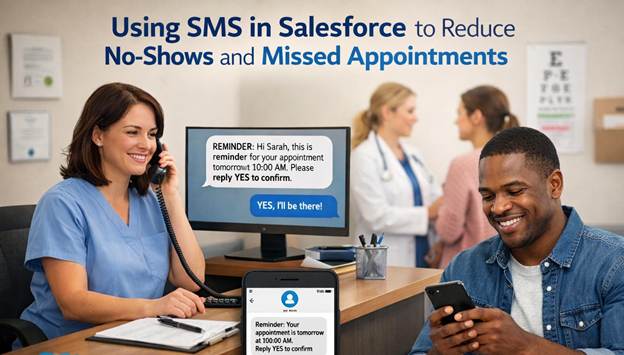
In today’s modern business landscape, missed appointments translate to lost opportunities. Irrespective of the industry you belong to, missed opportunities might cost businesses a fortune. Similarly, no shows don’t just lead to wastage of time but also leads to lower morale, reduced productivity, and delayed outcome.
In fact, no shows are more than just inconvenient as in many cases they impact your revenue. Though, it isn’t premediated, people tend to overlook a calendar invite suppressed in an inbox usually, especially when they have to juggle multiple responsibilities. So, what is the solution? Salesforce ecosystem encloses a built-in solution that can help businesses to deal with these issues.
SMS Automation in Salesforce
When SMS is embedded deeply within Salesforce, no shows can be significantly reduced. And unlike email or phone calls, SMS tend to reach people where they actually pay attention.
Let’s explore how a Salesforce SMS App can transform appointment management — and why it has become crucial for any customer-centric business.
What Leads to Missed Appointments?
Missed appointments mostly happen when people overlook reminders and are uncertain about rescheduling. Many times, they don’t feel the need to confirm. Emails get lost in crowded inbox, phone calls go unanswered, and calendar invites gets buried. With a 98% open rate, SMS is usually read within minutes, and when supported by a Salesforce AI chatbot, customers can instantly confirm, cancel, or reschedule appointments without human intervention.
How Does a Salesforce Messaging App Fix this Issue?
Salesforce manages critical data — from contact and lead details to appointment details, assigned reps, status updates, and engagement history. With SMS natively integrated inside Salesforce, it functions as a part of the customer’s record rather than an external tool. The outcome is an automated workflow where automated events generate reminders, records are updated, agents are notified, and follow-ups run on their own. There’s no manual tracking, and no missing details as everything flows across Salesforce.
Instant Confirmation: Right when an appointment is created, an SMS is sent by default to the customer. This instant message confirms that the number is authentic, prompting the customer to take action. This instantly separates serious prospects from the casual ones so your Salesforce team knows exactly where to focus.
Two-way Messaging to Make it More Impactful: One-way reminders are useful—but two-way SMS fosters better impact. With Salesforce, customers can reply with simple commands. Their response is written into Salesforce and instantly activates the right workflow. A cancellation paves the way for another customer. A reschedule creates a follow-up task for your team. Rather than speculating who will show up, you get immediate intent—turning ambiguity into action and removing silent no-shows.
Personalization Paves the Way for Commitment: Generic reminders fade in the backdrop. Personalized messages feel authentic and engaging. Since Salesforce stores every customer, as well as appointment detail, every SMS can be tailored using the customer’s name, the provider they’re meeting, the booked service, and the exact time, location, or meeting link. A personalized message creates a stronger impact than an automated one.
Massive Revenue Impact: For sales teams, field service groups, and appointment-based businesses, even a minimal drop in no-shows delivers instant financial returns. If a team manages hundred appointments per week with a typical value of Rs 10,000, a 20% no-show rate interprets into Rs 200,000 in lost revenue per week. Bringing that down to 10% using SMS reminders wins back majority of that lost value—without increasing marketing budgets. It is one of the most cost-efficient customizations an organization can make because it maximizes what businesses already have.
Optimal Customer Experience: The experience for customers gets outstandingly better. Rather than feeling ignored, they feel empowered and informed. They know about their exact appointment schedule, how to modify it, and rearrange if needed. Messages arrive on a channel they truly use, making communication simple and reliable. This removes frustration, lowers trust and eliminates misunderstandings. This helps build confidence in your brand. When businesses interact properly, it leads to better engagement, higher attendance and repeat business. In high stake industries such as financial services, where no-shows have serious consequences, SMS is a necessity.
Scalability Due to Automation: Without Salesforce SMS, teams are required to call or text customers manually, record responses, and apprise records by hand. This makes the process slow, expensive and error prone. When SMS is integrated into Salesforce, the entire workflow becomes automatic. Reminders are sent on their own, customer answers are seized instantly, schedules apprise in real time, and agents receive instant alerts. Leaders can access live dashboards showing reschedules, confirmations and attending trends. This allows businesses to shift from volatile firefighting to a data-driven appointment management.
Compliance and Trust: These are core to today’s Salesforce platforms. With opt-ins, message templates, consent tracking, and audit logs managed inside Salesforce, organizations can stay aligned with regulatory guidelines while communicating confidently. Customers comprehend why they are being contacted, and businesses gain complete visibility into communication trail. This adds a layer of professionalism and transparency — especially in regulated industries.
What Sets Apart a Salesforce SMS App from its Generic Counterpart?
What truly sets Salesforce SMS platform from its generic counterpart is its linking to the CRM. An independent SMS platform can send reminders, but it cannot update deals, present workflows, or impact customer journeys. Salesforce SMS operates within the core business engine. When a client authorizes an appointment, Salesforce by default advances them to the next stage in the pipeline. In case they cancel, Salesforce can trigger a re-engagement campaign. If no one responds, Salesforce can direct the case to a live agent. Every text interaction becomes actionable data that drives smart next steps by default.
Final Words:
Reducing no-shows isn’t just about sending Automated SMS Reminders. it’s about constructing a two-way communication experience that is relatable to how customers live today. People reply to texts, expect instant response, and want quick ways to reschedule. Salesforce messaging meets them on their phones, changing every appointment into a high-probability interaction. The result is scarcer unfilled slots, greater revenue, stronger client trust, and more expectable business outcomes.


More Stories
Why Digital Marketing Agencies Need SOC 2 Compliance to Launch and Scale in the US Market
Instagram PR Full Form: A Complete Guide for Social Media Users
Short-Form Video Dominance: Lessons from TikTok and YouTube Shorts