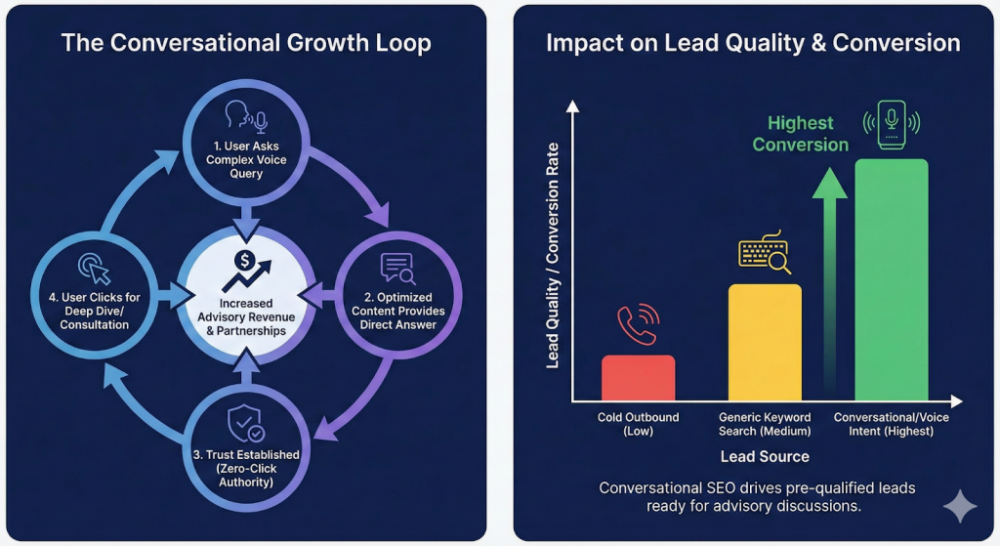
The way the world searches for money advice is changing. It was not long ago that a user would type “best credit card 2026” into a search bar and scan ten blue links. Today, that same user is just as likely to ask a smart speaker while cooking dinner, “Hey, what’s a good travel card with low fees?” or type a complex scenario into a chatbot: “I have a 720 credit score and want to transfer a balance. What are my best options?”
For fintech professionals, this is a massive shift. We are moving from a “search” economy to an “answer” economy, where traditional optimization tactics often fall short. To adapt to this new landscape, forward-thinking brands are increasingly leveraging specialized AI Seo Services to ensure their digital presence is not just ranking for keywords, but effectively positioned as the single, trusted answer in a conversation.
The New Search Landscape: From Keywords to Conversations
Traditional SEO was often a game of matching keywords. If you had “high yield savings account” on your page enough times, you ranked. Conversational AI changes the rules because it seeks to understand intent and context, not just vocabulary.
When a user engages with voice search or a chat interface, their language becomes natural, messy, and specific. They stop using “search-speak” and start using human language.
Why Fintech Must Adapt Now
In financial services, trust is the currency. Conversational AI platforms prioritize sources that demonstrate high expertise, authority, and trustworthiness (E-E-A-T). If your content answers questions directly and authoritatively, AI models are more likely to cite you. If your content is buried in jargon or sales fluff, you will be bypassed.
- The Opportunity: You can capture users at the exact moment of decision-making.
- The Risk: If you ignore this shift, you lose visibility not just on Google, but on Siri, Alexa, and the growing list of AI chat assistants.
Decoding the Fintech User: Intent in a Voice-First World
To win at conversational SEO, you have to understand why someone uses voice or chat. Usually, it falls into three buckets, and your content needs to address each differently.
1. The “In-the-Moment” Query (Speed)
- User Scenario: A user is walking to a meeting or driving.
- Query: “What is the current exchange rate for USD to Euro?” or “Where is the nearest fee-free ATM?”
- Your Strategy: These users want data, not a story. Your site needs to present structured data (numbers, locations, rates) that AI can easily scrape and read aloud.
2. The “Educational” Inquiry (Trust)
- User Scenario: A user is researching a complex product but feels intimidated.
- Query: “What is the difference between a Roth IRA and a Traditional IRA for someone self-employed?”
- Your Strategy: This requires a direct, comparative answer. AI favors content that uses “is” definitions (e.g., “A Roth IRA is…”) and bulleted comparisons.
3. The “Advisory” Request (Guidance)
- User Scenario: A user is looking for a partner or a platform.
- Query: “Find me a wealth manager who specializes in tech equity compensation.”
- Your Strategy: This is where high value conversion happens. You need local SEO and clear value propositions that align with specific financial needs.
Optimization Strategy 1: The “Speakable” Content Framework
Writing for the eye is different from writing for the ear. When an AI reads an answer, it does not want to wade through a 300-word introduction. It wants the answer immediately.
The Inverted Pyramid Approach
Start every section of your blog or landing page with the direct answer (the “definition”), then expand on the details. This is often called “answering the Public.”
Do this:
What is tax-loss harvesting? Tax-loss harvesting is a strategy where an investor sells assets at a loss to offset a capital gains tax liability. This can help reduce your overall tax bill…
Avoid this:
In today’s complex financial environment, many investors are looking for ways to save money. One method that has become popular over the years is… (This is fluff. AI ignores this).
Targeting Long-Tail Question Keywords
Voice queries are longer than text queries. Use tools to find the “Who, What, Where, When, Why, and How” questions relevant to your niche.
- Instead of optimizing for: “Small business loans”
- Optimize for: “How do I qualify for a small business loan with bad credit?”
Actionable Tip: Update your headers (H2s and H3s) to be full questions. This signals to search engines that your specific section provides the answer.
Optimization Strategy 2: Technical SEO for the AI Era
You can write the best answers in the world, but if the bots can’t read your site, it doesn’t matter. Technical SEO for conversational AI focuses on structure and speed.
Schema Markup: The Translator
Schema markup is code that you put on your website to help search engines understand what your data means. For Fintech, this is non-negotiable. You should be using specific schemas to tag your content:
- FAQPage Schema: Explicitly tells Google “This is a question” and “This is the answer.” This is the gold standard for getting into Voice Search results.
- FinancialProduct Schema: Helps you tag interest rates, fees, and terms so AI can accurately compare your product against competitors.
- Speakable Schema: A newer tag that identifies sections of a news article or blog post that are best suited for audio playback (text-to-speech).
Site Speed and Mobile Usability
Voice searches happen predominantly on mobile devices. If your page takes 5 seconds to load, Siri isn’t going to wait for it. She will move to the next result. Your site must be mobile-responsive and lightning-fast to be considered a viable source for voice answers.
Optimization Strategy 3: Chatbots and On-Site Engagement
Optimizing for external AI (like Google) is half the battle. The other half is using Conversational AI on your own site to improve engagement signals.
Reducing Bounce Rates with AI Agents
When a user lands on your site from a search, they might be overwhelmed by complex financial charts. An on-site AI chatbot can immediately engage them: “Hi, I see you’re looking at mortgage rates. Do you want to see a comparison based on your credit score?”
This interaction increases “dwell time” (how long a user stays on your page), which is a massive ranking factor for SEO. It proves to Google that your page provided value.
Personalization at Scale
Modern AI tools allow you to serve dynamic content. If a user asks a voice query about “student loans,” your landing page can dynamically highlight your student loan refinancing tools rather than your retirement products. This relevance boosts conversion and lowers user frustration.
The Business Case: Driving Advisory Revenue through Search
Why does all this effort matter? Because conversational queries are often “high intent.” A user asking a specific financial question is usually ready to act whether that means opening an account, booking a consultation, or switching providers.
Capturing these queries is a direct pipeline to revenue growth. By positioning your brand as the “answer,” you build the trust required for high-stakes financial relationships.
Future-Proofing: Preparing for “Zero-Click” Dominance
We must address the elephant in the room: Zero-Click Searches. Often, voice assistants and AI chats give the answer without sending the user to your website.
- Is this bad? Not necessarily.
- The “Brand Authority” Play: Even if they don’t click, they hear your name. “According to Emblus, the best time to refinance is…” This builds immense brand equity.
- The “Deep Dive” Click: For complex financial topics, a short answer is not enough. If you provide the best summary, the user is likely to visit you for the full details, contracts, or application forms.
Summary of Opportunities
The transition to Conversational AI SEO is a strategic imperative that reframes digital marketing from targeting disjointed keywords to answering complete, conversational questions. For Fintech companies, where trust is paramount, this shift is critical because authority is now built by providing direct, accurate answers to complex financial queries rather than just ranking for terms. By evolving your strategy from keyword density to semantic relevance and integrating AI tools to handle routine interactions, you not only improve operational efficiency but also secure a significant competitive advantage as an innovative leader in a rapidly evolving, voice-first marketplace.



More Stories
Why Digital Marketing Agencies Need SOC 2 Compliance to Launch and Scale in the US Market
Using SMS in Salesforce to Reduce No-Shows and Missed Appointments
Instagram PR Full Form: A Complete Guide for Social Media Users