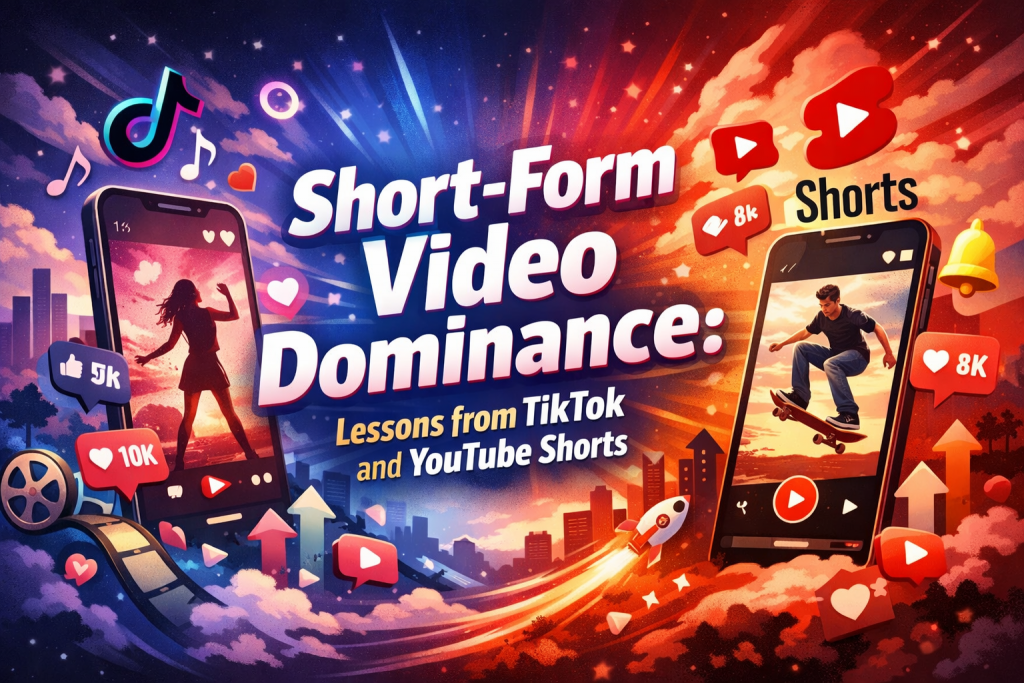
Every marketer, creator and media executive has a point of reference; the moment when they were scrolling through a short-form video feed and lost thirty minutes of their time unaware. Such an experience, repeated billions of times, on billions of devices, is the most sincere argument to explain why the short-form video is now the most characteristic type of content of the digital era. TikTok built the template. YouTube Shorts expanded it to a worldwide infrastructure. Instagram Reels followed. And thus, they all read the new guidelines of attention, creativity, and brand communication in such a way that continues to be written in 2026.
This is not merely a narrative of an up-to-date content format. It is a narrative of a radical change in the way human beings access information, find products, shape opinion and relate to the culture. Among the lessons that can be learned in the history of the short-form video is the rise, which is one of the most valuable ones that any communicator, brand strategist, or content creator should learn.
The Architecture of Addiction: How Short-Form Video Captured Attention
The answer to one of the questions to get you in a position to know why short-form video prevails, you have to begin not with the content, but with the engineering. The For You Page, which is the recommendation algorithm of TikTok, was an actual revolution product choice. Contrary to platforms that structured content based on social graphs (who you follow, who follows you), Tik Tok structured content based on interest graphs (what you actually engage with, regardless of the source).
This difference is technical but its consequences were colossal. On Facebook or early Instagram, a new creator that had zero followers had virtually no opportunity of organic reach. On Tik Tok a teenager in a small town with a captivating video could get to ten million people overnight. It made distribution democratic in a manner never seen by any social platform and it produced an environment in which the content itself, and not the audience that the creator had, determined success.
YouTube shorts came later, yet they managed to introduce a powerful asset to the format the YouTube ecosystem. An artist with a strong long form subscriber base would be able to cross-promote short-form content and the other way around. The ad revenue sharing system of YouTube comment finder that TikTok was slow to replicate on a similar level provided creators with a direct monetary incentive to invest on Shorts. It led to a flight of professional makers that introduced a production quality and audience development skills to the short-form arena.
Combined, the two platforms ensured that the short-form video was not a drill or a craze. It was a content consumption behaviour of structural change.
The Death of the Hook Delay: Attention in Three Seconds or Never
The most influential result of the emergence of short-form video perhaps is what has changed viewers of time expectations. The long-form content is based on the principle of investment, the viewer invests time initially in order to get a payoff in the future. This was the opposite of short-form video.
On Tik Tok and YouTube Shorts, creators soon found out that they had about two to three seconds to procure continued attention before a viewer swiped away. Such vicious succinctness necessitated a new creative art: the art of the instant hook. Any successful short-form video provides an answer to the question why should I continue watching. when it was first conceived — with an unexpected word, with a suspense that stays open, with a visual framework that is disrupted, with an emotional stimulus that brings about an authentic interest.
This lesson has gone well beyond social media. Marketers are using the three-second hook principle to email subject lines, creative of ads, the hero section of websites, and even sales presentations. This is true not only of the context of infinite content choice, but it can be seen everywhere: you do not get to build to your point in a world of infinite content choice. Your point has to come first and then all the rest comes.
What it means to brands is unpleasant, but obvious. The old funnel of communication storytelling structures where the context begins, the background proceeds, and the value it delivers is reached in the end are becoming less effective. The finest brand communicators in a short form age are the one that put the result, the feeling, or the surprise first and the clarification last.
Authenticity as Strategy: The Creator Economy’s Biggest Lesson
It is one of the most notable discoveries to come out of the short-form video culture that production value does not necessarily translate into performance. The videos that have received the most views, the most shares, the most benefits in terms of purchases on Tik Tok were shot in dim light, on an old smartphone, and by a person with no media training whatsoever. It was first confusing to advertising agents who were used to viewing budget as quality and quality as results.
This can be explained by trust. Authenticity has become a high level of sensitivity among consumers, especially the younger individuals. Excessive content is an indicator of a transaction a brand attempting to sell something. Unpolished, unfiltered, unethical content is an indication of an individual who has something to share. And individuals have a lot more faith in people than in brands.
This is the logic behind the creator economy which has thrived alongside the emergence of short-form video. Makers – be it with ten thousand or ten million followers – possess something that no brand could work up: an existing bond of trust with a certain audience. When a creator suggests a product in the same tone, and style that they use to tell everything about their life, they have an authenticity premium that cannot be emulated by an advertisement.
This is a twofold lesson to the brands. One, make investments in creator partnerships with a gravitas that you would make investments in any major media channel, since it is now the leading media channel among most of the consumer demographics that are under forty. Two, do not be tempted to tell creators what to do. The biggest error that brands commit in influencer marketing is that they view creators as human billboards, give scripts, require messages, and insist on approval of each frame. The best creator content is the type of content that seems to belong to the creator – since it is mostly so.
Sound as Identity: The Audio Dimension of Short-Form Culture
The short-form video is commonly addressed in the visual aspects, although audio is also at the center of the cultural operations of video. In particular, TikTok created a culture of sound-first where audio clips, both original, remixed music, voiceovers, and snippets of dialogue can be made into their own meme, disconnected to the original video and reused by millions of later posts.
This creates a challenge and opportunity to the brands. The opportunity is scalable sonic branding. A brand that invents a unique sounding – an original jingle, a memorable audio logo, a phrase spoken in a specific cadence, etc., may have that sound imitated naturally by thousands of designers, and all these designers make the brand go viral without spending extra money on media. This is precisely what some consumer brands have accomplished, and with original sounds they planted on Tik Tok they received hundreds of millions of organic views due to organic creator participation.
It is about navigating the music licensing in the environment where trending audio is part of the performance of content. Both YouTube Shorts and Tik Tok have large collections of licensed music, although the brands have fewer opportunities to use popular music in their commercials than personal creators. It has expedited investment in original music creation by progressive marketing teams not as an expense centre, but as a real brand asset.
The Conversion Architecture: How Short-Form Video Sells
The influence of short-form video on business has been among the largest – and more importantly the most startling – changes that have occurred over the last few years. The cultural meme of TikTok made me buy it became a real commercial category, as the hashtag with tens of billions of views has a direct effect on the trends of products, retail sell-outs, and category discovery trends in the consumer goods market.
It is a process that could be referred to as discovery commerce, which involves making of purchase decisions that are not motivated by a search motive but rather by content exposure. A consumer was not seeking a particular product. They were exposed to it in a video which proved the product in the real life and a real human experience with the product and made them believe that they were learning about something and not being sold anything. Such a sensation, organic discovery, not commercial push, is especially strong and it is one that has not been so effectively mimicked by any of the conventional advertising formulas.
The YouTube Shorts have built upon this with direct shoppable integrations that enable products to be tagged in the video creating a nearly zero distance between discovery and purchase. In-app commerce based on short-form content has shown a TikTok Shop can be capable of creating astounding sales velocity in the event of the content being genuine and a good product-market fit.
The moral of the story is that the distinction between brand-building content and performance content is falling down. One well-designed short video can be the equivalent of brand recognition, emotional/affinity, product value, and direct-to-consumer acquisition. This intersect requires creative, brand, and performance marketing units, which are traditionally separated, to be integrated in truly integrated manners.
What Comes Next: The Sustained Lessons of a Format That Changed Everything
Video texting is not the highest point. The format also remains in flux, with longer-duration formats in the short-form platform (extending the Shorts service of YouTube to three minutes, as an example), involving AI creation in workflows of creators, and further expansion of commerce and community capabilities on all platforms.
Nevertheless, the most significant lessons of Tik Tok and YouTube Shorts do not apply to platforms. They are values that will succeed any application.
Driving attention should not be presupposed but obtained. In a trust economy, authenticity is better than production. The content that is distributed is interesting and not by existing audiences. Auditory and visual arts are combined to produce cultural instances. Discovery is the new search. And the distinction between content and commerce has all been practically erased.
To any brand, marketer, or creator operating in the digital environment, they are not any tactical footnotes. they are strategic necessities, lessons that have been hard earned in the most competitive attention marketplace ever devised, and that can be absolutely applied to the next formats and platforms.
The age of short-form videos taught the world that even thirty seconds used with purpose can make the difference.



More Stories
How to Choose the Best SEO Company in Singapore for Your Business
How Transparent VAT Pricing Can Improve Shopify Store Conversions
How Health Brands Can Use Visual Search to Reach More Consumers