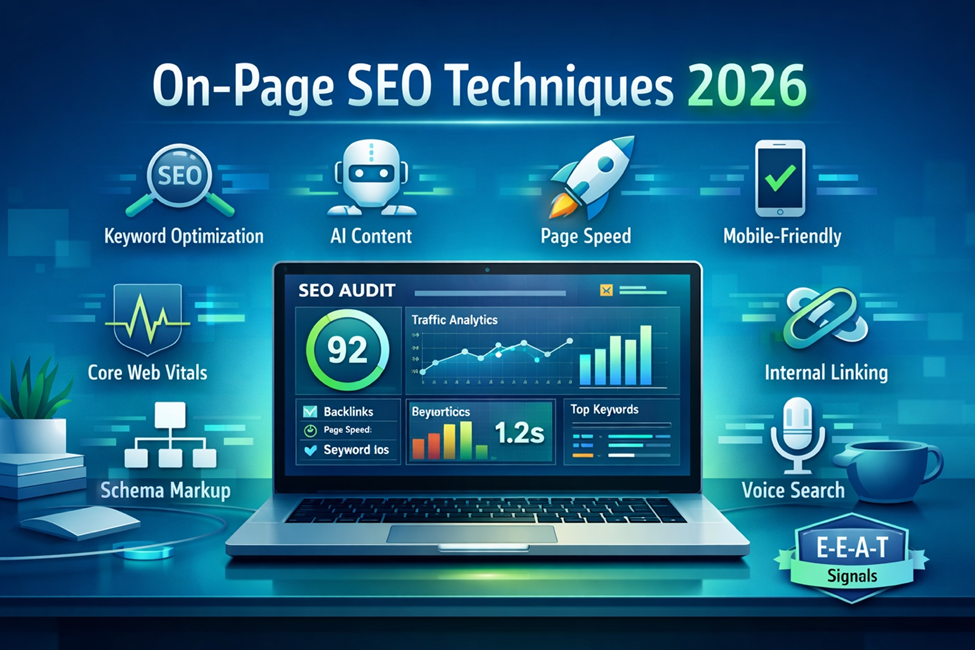
If you think SEO is still just about stuffing keywords into a meta description, I have news for you: the game has changed. As we move through 2026, search engines like Google have evolved from simple link-indexers into modern “Answer Engines.” Today, ranking at the top of Google Search requires a lot of technical precision, instant focus content, storytelling, and a deep understanding of AI-driven search behaviours.
Whether you are a business owner trying to rank your business website or you are a student looking to learn on-page SEO, staying ahead of these trends is non-negotiable.
In this guide, we will share with you the top 7 page SEO techniques that you should follow and that are actually moving the needle this year.
1. Mastering Search Intent and Semantic Content
In 2026, Google doesn’t just look at the words you type; it looks at what you actually mean, this is known as semantic search. Instead of optimizing for a single focus keyword, the advanced on-page SEO strategies now involve to topic clusters for better ranking.
You need to cover a subject in deep that search engines see you as an authority. If you’re writing about digital marketing, don’t just mention the term once, talk about the strategy, the tools, the ROI, and the common pitfalls. By satisfying the user’s “informational” or “transactional” intent with your content correctly, you can easily reduce bounce rates—a signal that is more important now than ever.
2. Optimizing for AI Overviews and Zero-Click Search
We are living in the era of Generative Engine Optimisation (GEO). Have you noticed how Google often provides a summary at the top of the page? That’s an AI Overview. To get featured here, your content must be structured in a way that AI can easily “digest.”
One of the best on-page SEO checklist 2026 tips is to include a “TL;DR” (Too Long; Didn’t Read) summary at the start of your articles. Use clear, concise sentences that answer the primary question of the page within the first 100 words. This makes it incredibly easy for Google’s AI to pull your site as a cited source.
3. The Power of E-E-A-T (Experience, Expertise, Authoritativeness, Trust)
With the internet flooded with AI-generated fluff, “Experience” has become the “E” that matters most. Google wants to see that a real human with real lived experience wrote the content.
If you are looking for the best on-page SEO techniques, you’ll find that the most successful blogs now include:
- Author Bios: Detailed descriptions of the writer’s credentials.
- Personal Insights: Adding “I tried this” or “In my experience” to provide unique value.
- First-Hand Data: Original case studies or surveys that AI cannot replicate.
4. Technical Excellence: Core Web Vitals 2.0
Speed is no longer a “bonus”—it’s a requirement. By 2026, Core Web Vitals will have expanded to focus heavily on “Interaction to Next Paint” (INP). This measures how fast your site responds when a user actually clicks something. You can check the INP of your site with https://pagespeed.web.dev/.
If your site feels laggy on a mobile device, your rankings will suffer. Many students enrolled in an SEO course spend lots of time learning how to optimize JavaScript and compress images into Next-Gen formats like WebP. A fast site keeps users engaged, and engagement is a massive ranking factor.
5. Structuring Content with Advanced Schema Markup
Think of Schema Markup as a translator that speaks directly to search engine bots. In 2026, using the basic “Article” schema is not enough. You need to implement and optimize your website for:
- FAQ Schema: To capture more real estate on the search results page.
- Review Schema: To show star ratings and build immediate trust.
- Organization Schema: To help Google understand your brand’s entity.
In 2026, structured data is one of the main things that helps your website stand out in a crowded digital content landscape and rank better in SERP.
6. Conversational Content for Voice Search
“Hey Siri, what are the top SEO trends?”
Voice search is no longer a gimmick; it’s a primary way people use to find information. Because people speak and type differently, your headers should reflect natural language.
Instead of writing “SEO Benefits” in the heading, it is better to write “Why is SEO important for my small business?” This conversational tone aligns perfectly with how voice assistants retrieve information, making it a staple in any modern on-page SEO checklist 2026 recommends.
7. Mobile-First and Thumb-First Design
In past, we focused on mobile-friendly design, but now in 2026, we need to focus on “Thumb-First” navigation. Ask yourself a few questions:
- Can your Call-to-Action (CTA) button be easily hit with a thumb?
- Is your font size large enough to read without zooming the content?
Google’s mobile-first indexing means the mobile version of your site *is* your site. If the mobile experience is clunky, your desktop rankings will be affected, too.
Why Local Context Matters When It Comes To Better Ranking This Year?
If you are a local business owner, general SEO isn’t enough. You need to dominate your neighbourhood. Applying advanced on-page SEO strategies involves optimizing for ‘near me’ keywords and ensuring your Name, Address, and Phone number (NAP) are available on your website and your Google Business Profile, and Contact Us and About Us pages must be there with all business details.
Summary Checklist for 2026:
- Focus on Search Intent instead, then use the focus keywords and LSI keywords everywhere in the content.
- Use Schema Markup to help AI engines understand your content correctly.
- Prioritise website loading speed on Mobile devices, specifically the INP metric.
- Build E-E-A-T by adding personal experiences and author details such as photo, name and short bio.
- Use Conversational Headers to capture voice search traffic.
Conclusion
On-page SEO in 2026 is essential. You have to write the content that satisfies the intent to keep your visitors engaged, but you also have to structure your content for AI to ensure you get retrieved and cited.
Just by focusing on high-quality, experience-driven, intent-focused content and maintaining a lightning-fast loading speed, you can stay ahead of the curve.
Success in search ranking is not about just randomly trying different SEO optimization techniques; it is all about providing the best possible and to-the-point answer to the user’s search queries.
Whether you’re a pro or just starting your journey, remember that consistency is key.

More Stories
What Makes a Gojek Clone App Different from Other Multi-Service Apps?
How to Choose the Best SEO Company in USA for Your Business
Uber Clone Web Booking vs Mobile App Booking: Which Is Better?