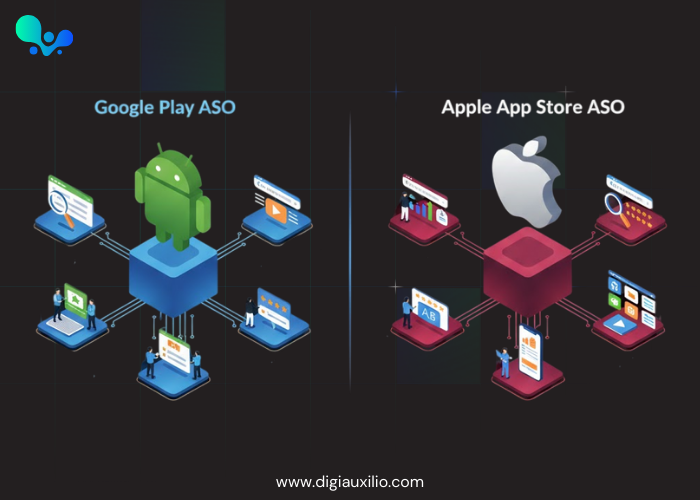
The key to the success of mobile applications lies in discoverability. Your exclusive app will be of no use if it goes unnoticed in the presence of other rivals in the market with millions of applications. The knowledge about the different optimization approaches for the Google Play Store and the Apple App Store becomes essential to maximize downloads for both platforms. This awareness will prove crucial regardless of whether it’s done in-house or through a professional ASO.
Both of the most popular app stores function according to a completely different algorithm and emphasize different factors for ranking. Every different algorithm provides a distinct opportunity for optimization. It is a waste of resources to approach both of them with a common strategy. Smart developers and marketers of businesses use app optimization services.
Understanding Platform Differences
Google Play Store and Apple App Store have the same end objective—enabling users to find suitable applications. However, the strategies adopted by the two companies to achieve the objective differ considerably. Google relies heavily on keyword matching and engagement rates, while Apple relies on its curated applications and reviews.
These philosophical differences are realized in the optimization requirements of applications on these platforms. Google Play allows a total of 4,000 characters in the description and indexes all words in the description for search purposes. The Apple App Store constrains the length of the description in smaller sizes, not indexing any words in the description for the purpose of ranking keywords.
Google Play Store Optimization Strategies
Keyword Optimization Approach
Google Play’s search algorithm indexes the entire app description, meaning there are massive keyword opportunities available. Keywords placed within the 4,000-character description enable search functionality for multiple search terms.
The brief description (80 characters) and detailed description also play important parts in this. App store optimization specialists study high-volume relevant words and use these words in the description without the need for repetition.
The weight given to title keywords is greater than the weight given to the two description categories combined. Pursuing the perfect keywords while also composing compelling copy to convert browsers into downloaders is not very easily achieved. This is an area where experienced ASO providers have the know-how to guide.
Localization Opportunities
Google Play supports 77 languages, which obviously provides tremendous opportunities for localizing an application to appeal to many users globally. Every localization can be assigned its unique set of keywords.
For ASO services for local businesses, this means tailoring app listings to specific geographic markets. A restaurant app in Mumbai uses different keywords than the same app marketed in Manchester, even when both target English speakers.
Visual Asset Requirements
The Google Play store showcases a feature graphic with a resolution of 1024 by 500 pixels, an icon, and up to eight screenshots, with the option of adding a video as well. Your feature graphic plays a vital role in the search result pages and store listings.
Screenshots should showcase main functionality and benefits. Users typically scan apps for mere seconds. Thus, storytelling through screenshots that showcase benefits right away plays a critical role. Performing A/B testing for various screenshot arrangements helps increase conversions.
Rating and Review Impact
The Google algorithm gives a great deal of importance to ratings and reviews. The apps that have a high rating and positive reviews get a high ranking and a better conversion rate. The ability to get positive reviews from satisfied users is an extremely important ongoing process.
Handling reviews, whether they be positive or negative, can be an indication that the developer is actively involved and can help to raise app ratings. AMP and many other ASO services often include review management tactics.
Apple App Store Optimization Strategies
Keyword Field Utilization
The Apple App Store has a different, 100-character keyword field invisible to the users. This is the field that only decides in which searches your application will appear, which means that keyword selection here is absolutely critical.
Unlike Google Play, Apple doesn’t index your description for search ranking. Those 100 characters represent the entirety of your keyword opportunity. Professional ASO services research and test keyword combinations obsessively to maximize this tight space.
Commas separate keywords without space-saving characters; repeating keywords is a waste of space. The keyword rank is also associated with the name of an app, allowing placing certain keywords there strategically.
Subtitle Optimization
Apple’s subtitle field of 30 characters shows up below your app name and also adds to keyword rankings: this prime real estate should include key keywords while remaining appealing to human readers.
The subtitle also appears in the search results and, therefore, can affect click-through rates. Balancing keyword optimization with persuasive messaging requires the right blend of skills that many businesses seek from ASO services for local businesses.
Visual Content Standards
The subtitle also appears in the search results and, therefore, can affect click-through rates. Balancing keyword optimization with persuasive messaging requires the right blend of skills that many businesses seek from ASO services for local businesses.
The application preview video, up to 30 seconds, autoplays when viewers view a listing. This makes the application preview video highly useful for showcasing value. But when it comes to creating application preview videos that can be viewed effectively without sound and immediately catch viewers’ attention, that’s not an easy task.
Editorial Features and Today Tab
The Today tab allows Apple to showcase curated apps and stories, offering a massive visibility increase. Regarding the editorial feature in the App Store, although it cannot be controlled, the following are considered an assurance for selection: superior design quality, innovation, timeliness, and strict adherence to the design specifications set by Apple.
App optimization services help ensure that the app is of the highest quality for acceptance by Apple’s App Store standards and ready for evaluation for potential features at the optimal time.
Platform-Specific Ranking Factors
Google Play Algorithm Priorities
The Google Play algorithm gives high preference to user engagement metrics such as install velocity (number of downloads over time), retention rates, rates of app uninstallation, and usage. The better the user engagement, the higher the ranking.
Conversion rate—the percentage of store visitors who download—significantly impacts rankings. Optimizing visual assets, descriptions, and social proof improves conversion and subsequently rankings.
App updates signal active development. Regular updates with meaningful improvements demonstrate ongoing commitment and can boost rankings, especially when accompanied by positive user feedback.
Apple App Store Algorithm Priorities
Apple prioritizes user ratings and reviews even more heavily than Google. The volume and recency of ratings both factor into rankings and conversion rates.
Download velocity matters, but Apple seems to weigh rating quality more than Google does. An app with fewer downloads but exceptional ratings often outranks higher-volume apps with mediocre ratings.
Apple also considers user retention and engagement but less transparently than Google. The exact algorithmic weights remain more opaque, making testing and iteration crucial components of effective ASO services.
Localization Strategy Differences
Google Play’s support for 77 languages versus Apple’s support for 40 languages creates different localization opportunities. However, both platforms benefit enormously from proper localization beyond simple translation.
Effective localization for ASO services for local businesses means adapting keywords to local search behaviors, adjusting visual content for cultural preferences, and modifying messaging to resonate with regional values and communication styles.
Screenshots might emphasize different features in different markets. Keywords that work in one region may have different search volumes or competition levels elsewhere. Professional app store optimization services conduct market-specific research rather than applying one-size-fits-all approaches.
Review and Rating Management Across Platforms
Both platforms let developers reply to reviews, but the way it plays out isn’t quite the same. On Google Play, users can go back and edit their reviews after a developer responds. That’s a real chance to fix a bad experience and maybe even turn it into a glowing review, just by handling customer service well.
It’s different on iOS. Apple users can see what developers say, but if they want to change their review, they basically have to delete it and start over. So, it’s even more important to make sure users have a great experience from the start—there’s less room to recover from a bad review.
Timing matters for asking users to leave reviews. If you ask when someone’s happy—maybe right after they finish something successfully—they’re much more likely to leave a good review. Both Apple and Google give developers built-in tools for asking at just the right moments.
A/B Testing Capabilities
Google Play goes a step further with native A/B testing. Through the Play Console, developers can test out different images, descriptions, and icons and see what works best—all right there, no extra tools needed.
On the other hand, the Apple App Store doesn’t have built-in A/B testing. Developers have to rely on third-party tools or figure out their own ways to test. Because of that, getting the best results on the App Store often means leaning on best practices and industry know-how, especially from people who focus on ASO for a living.
Cross-Platform ASO Strategy
Despite platform differences, some optimization principles apply universally. Compelling visual design, clear value communication, social proof through ratings, and responsive user support benefit apps on both stores.
Many businesses develop integrated strategies addressing both platforms while respecting their unique requirements. Working with experienced app store optimization services ensures platform-specific tactics align with overall mobile strategy rather than creating fragmented, inconsistent approaches.
Frequently Asked Questions
Which platform is easier to optimize: Google Play or Apple App Store?
Google Play gives you more ways to tweak your app’s listing—like full description indexing, extra visuals, and built-in A/B testing. It’s a bit more flexible that way. Apple, on the other hand, keeps things simple: focus on the 100-character keyword field. Once you get how it works, it’s pretty straightforward. In the end, neither platform is easier. They’re just different.
Do I need separate ASO services for each platform?
Good ASO services—whether for local businesses or big enterprise apps—know how to work with both stores. Some agencies stick to just one platform, but the best handle both, using strategies that fit each store while still going after the same overall goals.
Can the same keywords work on both Google Play and Apple App Store?
Do you need different keyword strategies for Google Play and the App Store? Most of the time, yes. Search habits, competition, and character limits all vary between the two. That’s why pros research keywords separately for each platform, instead of just copying and pasting the same list.
How much should local businesses budget for ASO services?
Starting ASO services usually costs about $500 to $1,000 for the first round of optimization. For local businesses that want ongoing help, you’re looking at $500 to $2,000 a month, depending on how tough your market is, how many regions you target, and what you need. For enterprise apps, monthly ASO can run anywhere from $3,000 up to $10,000 or more if you want the whole package.
Do ratings impact rankings equally on both platforms?
Ratings matter a lot for rankings on both stores, but Apple seems to lean on them even more than Google. Both stores also look at how many new ratings you get lately, not just your all-time average. So, keeping those fresh reviews coming in really pays off.
Should I launch on both platforms simultaneously?
Not always. A lot of developers start with just one platform. They get feedback from real users, tweak the app, and then roll it out on another platform with those updates in place. This way, they learn what works, build up some credibility, and make a better impression when they expand. If you’re not sure what’s best for your app, app store optimization experts can help you figure out the right launch plan for your needs.


More Stories
What Makes a Gojek Clone App Different from Other Multi-Service Apps?
How to Choose the Best SEO Company in USA for Your Business
Uber Clone Web Booking vs Mobile App Booking: Which Is Better?